



































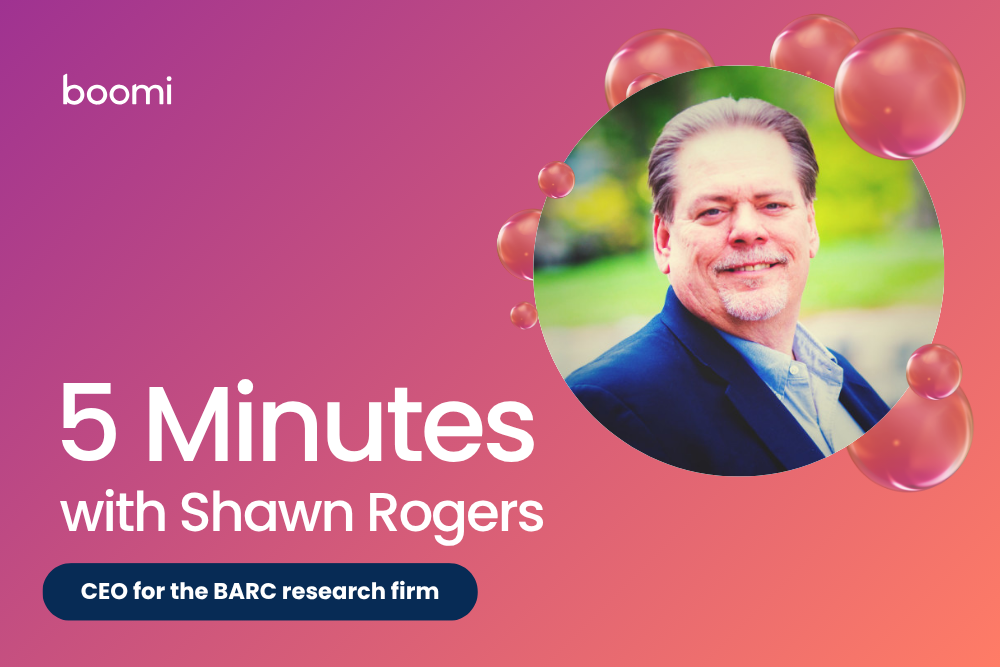
Boomi highlights business thought leaders, the trends they see, and the interesting things their organizations are doing. We focus especially on their views about the rapid advances in AI.
When Shawn Rogers spoke at Boomi World 2025, he started his session with a simple message: relax. He told the audience to take a deep breath. The AI train hadn’t left the station yet, so tamp down those fears of missing out. You have plenty of time to climb aboard.
His message was much different at this year’s conference.
“The train is moving now, and it’s moving fast,” said Rogers, the U.S. CEO for the BARC research firm. “There are few things I’ve seen that are as disruptive during my time as an analyst. If you’re not doing agentic work and using these tools at the workplace right now, you are falling behind.”
While that “get moving” urgency is a common refrain, Rogers has a more nuanced view of what that looks like in practice. He presented BARC research showing why so many businesses are struggling with AI implementation. They haven’t put in the necessary groundwork. The firm’s survey of global leaders, “Lessons From the Leading Edge,” found that only about 20% of organizations excel across seven foundational categories, including leadership, governance, data access, and security.
“Everyone is trying to move super-fast with AI right now, but most are doing AI without the proper safeguards,” Rogers said. “Your board says you have to do AI. Maybe you avoid the CEO in the hallway because every time he or she asks how the AI project is going. I get that. But if you want to be a hero at work, sit your team down and talk to them about what a really smart, responsible AI program looks like.”
Rogers, who is responsible for the company’s analyst coverage in North America, based his talk on multiple BARC reports. Highlights included an explanation of their AI maturity model, growing concerns about costs, and the heightened importance of high-quality data. The following has been edited for length and clarity.
What a difference a year makes.
Shawn Rogers: When I told everyone to take a deep breath at Boomi World last year, there was a lot of nervous laughter in the room. But FOMO is a very interesting issue with AI right now. Everybody feels like they could miss out on the opportunity. Plus, most people are feeling a new pressure around AI. It’s coming from the CEO. It’s coming from the board. It’s coming from the CFO because they won’t pass a project through that doesn’t have the letters “AI” in it.
What responsible AI really means.
Shawn Rogers: If you’re not familiar with the term “responsible AI,” it’s simply how your business decides how it’s going to handle AI. How are you going to handle the data? How are you going to handle models? How are you going to handle bias? It’s different for every business. Some companies want to be a little bit more aggressive, and some want to be a little bit more conservative. Oftentimes, that decision is driven by the business you’re in. If you’re in a highly governed business, like life sciences or financial services, you’re probably a little more conservative.
Why he believes most businesses aren’t AI-ready.
Shawn Rogers: We do a lot of longitudinal research, where we ask the same question repeatedly. We have a 2024 AI survey that we can compare to our 2025 report, which we published last December at AWS re:Invent. We have 441 responses from professionals around the world. We found that the ratio of leaders to followers is about 20-80 right now. In other words, 80% of businesses have not fully formalized the seven foundational areas we’ve identified for leaders in AI implementation maturity: leadership, policies, oversight, architecture, legal, security, and data access. Right now, we see leaders in the space – progressive or mature companies – as those that have really gotten to the point where they’re fully deployed, or they’re in the final stage of reviewing and revising.
But it’s not all sunshine for the AI leaders.
Shawn Rogers: The 20% doesn’t face the same challenge to success as the 80%. That 80% is still looking for prompt engineers, still buying software, and still trying to figure out everything. But you want to know what the 20% is worried about? Cost. They got to cost quickly because they’re doing more complex work.
AI and shiny objects.
Shawn Rogers: We do a lot of work with companies where we’ll see an initial, over-excited phase around technology that’s like hysteria, I call them bright shiny balloons of tech. People just follow them around and think they’re going to solve everything. It’s the same with people who say AI’s just going to do everything accurately and perfectly. But for responsible AI, you need frameworks and a foundation. It’s why people are realizing that data quality is an issue. We’re seeing companies that can integrate and control the data will have context pipelines for AI. If you’re laying the foundation, can get your hands on all the quality data, and you can bring it into the models in a smart way, you will be able to start surpassing your competition in the market.
First time he heard about agents.
Shawn Rogers: As I said, this is probably the fastest-moving disruptor we’ve ever witnessed in our careers. I run a research-driven analyst organization, and our market perspective is always based on actual data. So, I don’t normally promote or praise software companies. But I will say this. (Boomi CEO) Steve Lucas was the first guy to say the word “agent” in front of me. As vendors go, Boomi was one of the very first I saw in the industry to look at agents and agentic AI. Boomi could clearly see that something was coming. Boomi’s ahead of the market a bit, and they’re positioning themselves to intersect with companies as they become a little bit more of a leader than a follower. So, customers are coupled to a pretty smart train.
Take-home message for doing AI right.
Shawn Rogers: A couple of things. The train’s leaving the station. You can still hop on it, but if you haven’t yet, you’re starting to fall behind. Most enterprises are passing through the experimentation stage with agents. Governance decisions can’t wait. Don’t outpace it. Think about how to keep yourself out of trouble. What we’re going to see through the rest of 2026 is people like me writing stories about companies that made really big, bad errors with AI. Don’t be in Shawn’s story! Avoid it! Be the person who raises their hand in the meeting and says, “Hey, can we pump our brakes and do some things so that we can start to scale in the right way?” Everyone wants to scale AI with one success after another. But only one in five organizations has the foundation to scale that way. It all comes back to that list of seven things. This is not something you want to get too far down the road without that foundation for success. It’s also something that’s going to keep you out of trouble.
Up Close With BARC and Shawn Rogers
 About BARC: Founded in Germany in 1999, BARC specializes in unbiased, trusted research for data and analytics, and enterprise software. The firm serves more than 2,000 clients each year with over 13,000 participants at BARC events.
About Shawn: Rogers’ arrival at BARC in 2022 marked the firm’s expansion into the U.S. market. His wealth of experience in business leadership roles includes vice president, analytics strategy and corporate marketing at TIBCO, director of global marketing and channels at Dell Technologies, and running his own data and analytics consultancy.