
































How It Works
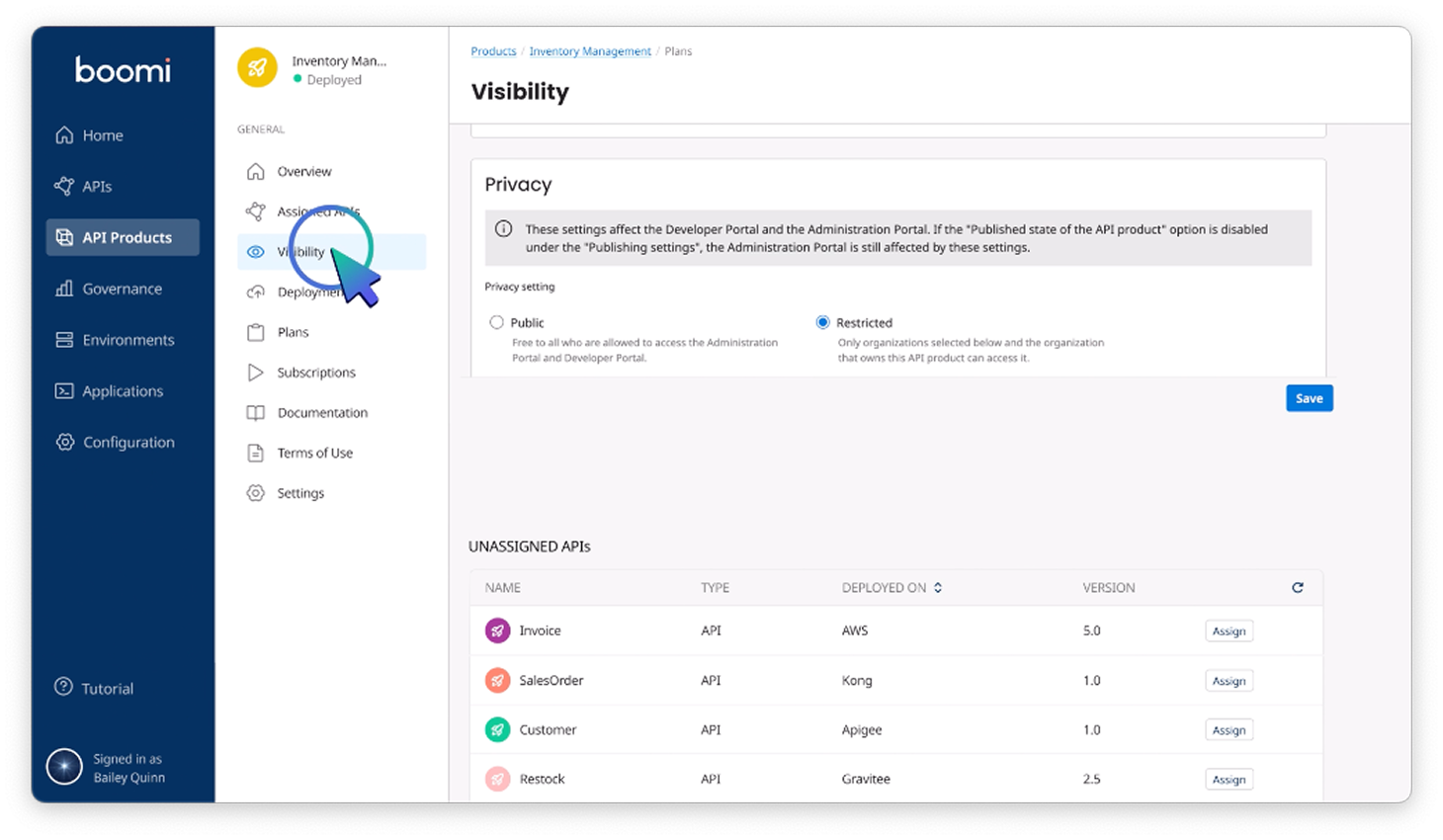
Leverage internal and external APIs as strategic assets to power new business models, elevate customer satisfaction, and stay ahead of emerging technologies and market shifts.
Forge partnerships, fuel growth.
Unlock new digital products, partnerships, and AI business models by turning APIs into business-ready services and managing secure access through subscriptions.
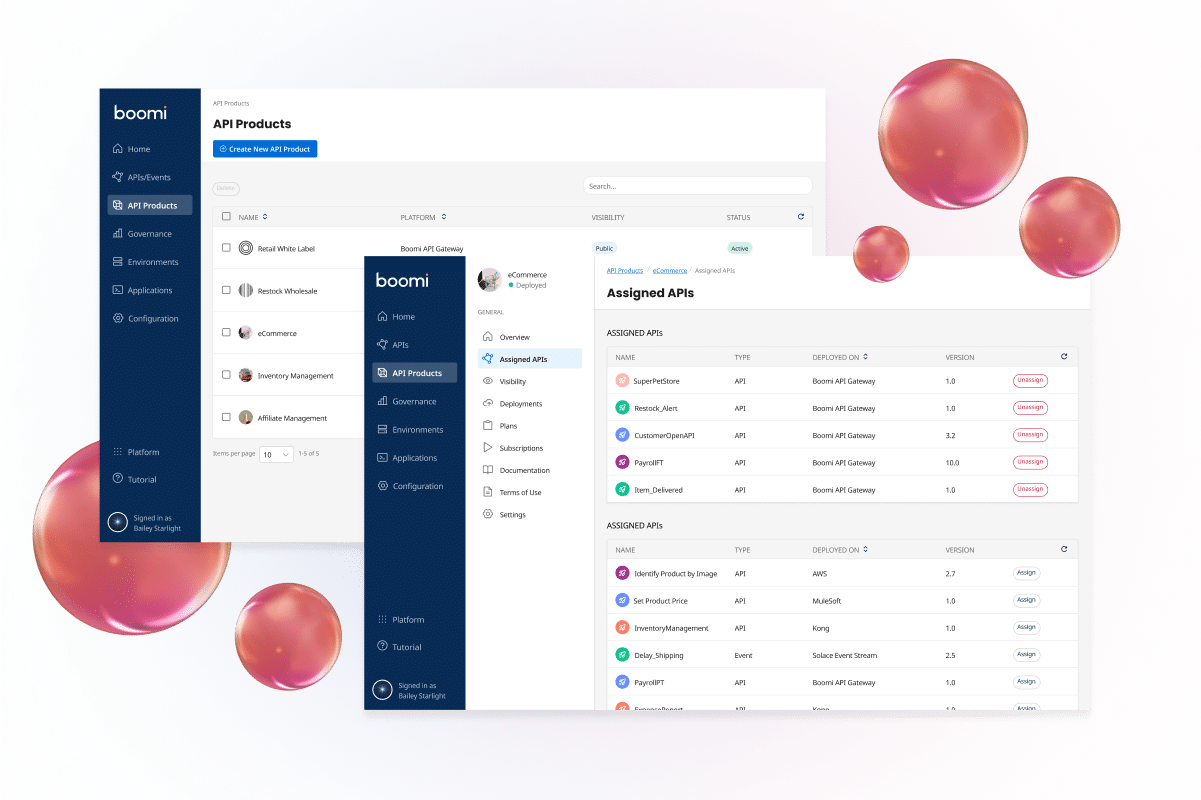
Accelerate adoption, ignite innovation.
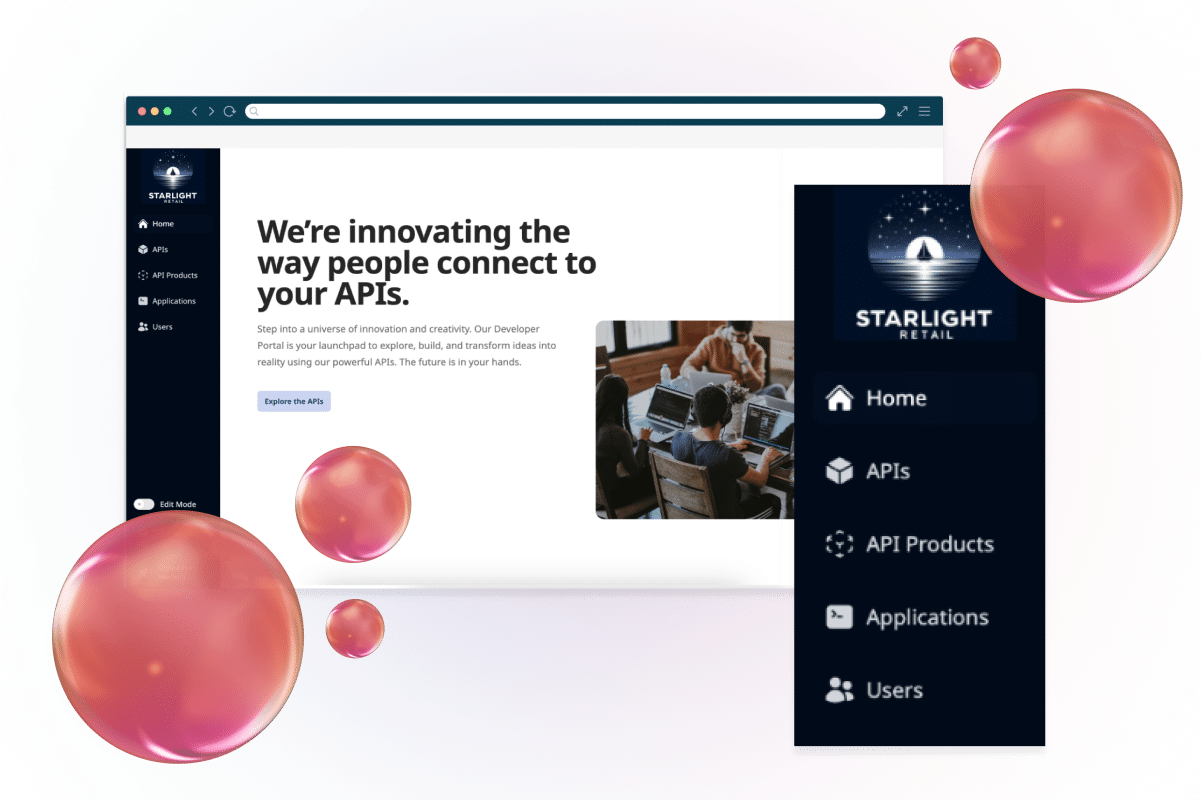
Maximize API impact and ROI with full-featured, customizable developer portals that make APIs easy to discover, invoke, and consume—for developers and agents.
Unlock value, lead the future.
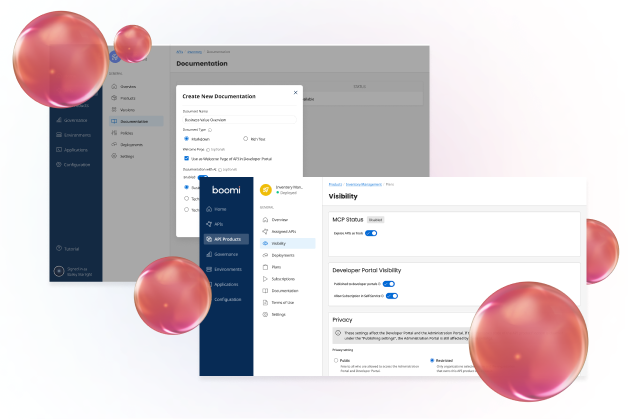
Empower AI agents to securely and consistently consume APIs using standardized style guides, enterprise-wide policies, and clear documentation. Natively expose APIs as MCP servers while maintaining complete governance.
Why Boomi for API Management?
Power next-gen digital and AI innovation on trusted APIs
API Governance
Govern, standardize, and monitor any native or third-party API under one universal control plane
API Security
Protect your API landscape with complete oversight, built-in compliance, and advanced access controls and policy enforcement
Boomi Agentstudio
Build, manage, and govern native and third-party agents—and the APIs they use—on a single platform
Boomi MCP
Securely curate and expose both legacy and cloud APIs as MCP-enabled tools, enabling high-ROI agentic workflows
PTC Slashes API Development Time by 75% Along Its Path to Digital Transformation
Leading industrial software company drives digital transformation with new workstreams powered by APIs

Power of the Platform
Get more from your Boomi Enterprise Platform.
Seamless application integration
Move data back and forth between your applications and automate critical business processes.
Synchronize data across applications
Establish a centralized, secure data management service with Boomi Data Hub for seamless data discovery and governance.
Manage Agentic AI
Build data products used in Boomi Agentstudio to design, govern, and orchestrate all AI agents at scale.
Extend API management capabilities
Easily manage policy rules like cache and role-based access and provide visibility into API performance metrics with an API developer portal and dashboard.
What Our Customers Are Saying


API Products Resources
Explore all resources





FAQs
Boomi uses a major-minor-patch versioning system to maintain backward compatibility and manage API changes. It provides a centralized interface for tracking versions, handling deprecations, and ensuring smooth transitions throughout the API lifecycle.
Yes, Boomi’s API Lifecycle capability deploys and manages multiple versions of the same API concurrently, allowing new functionality to reach some consumers while others remain on a stable, existing version until they are ready to migrate.
Boomi offers an intuitive UI, detailed API documentation, step-by-step tutorials, API references, and sample code. Its developer portal includes prebuilt templates and easy customization to help developers onboard quickly and streamline integrations. Our community includes 310K+ members, APIM experts, and forums to help you along the way.
Boomi allows APIs to be packaged and monetized through usage-based pricing and access controls. It supports exposing APIs via developer portals, where partners can access documentation, manage subscriptions, and monitor usage.
MCP is a standard interface that lets AI agents connect to enterprise tools without a custom integration for each agent-tool pair. You can enable MCP for an API Product under Visibility by turning on Expose APIs as Tools and assigning an MCP Server Version. Each exposed API endpoint becomes a tool, with tool definitions generated automatically from the API’s existing OpenAPI specification.
Boomi’s MCP Registry is a centralized catalog of MCP servers built on Boomi, imported from external registries, or registered by administrators. By default it includes Boomi Connect, the Boomi MCP Registry of MCP-enabled API Products, and Anthropic’s Official MCP Registry, and you can connect any registry that follows the Anthropic MCP Registry specification. Sub-registries let you group specific servers and publish each group with its own MCP endpoint URL.