






























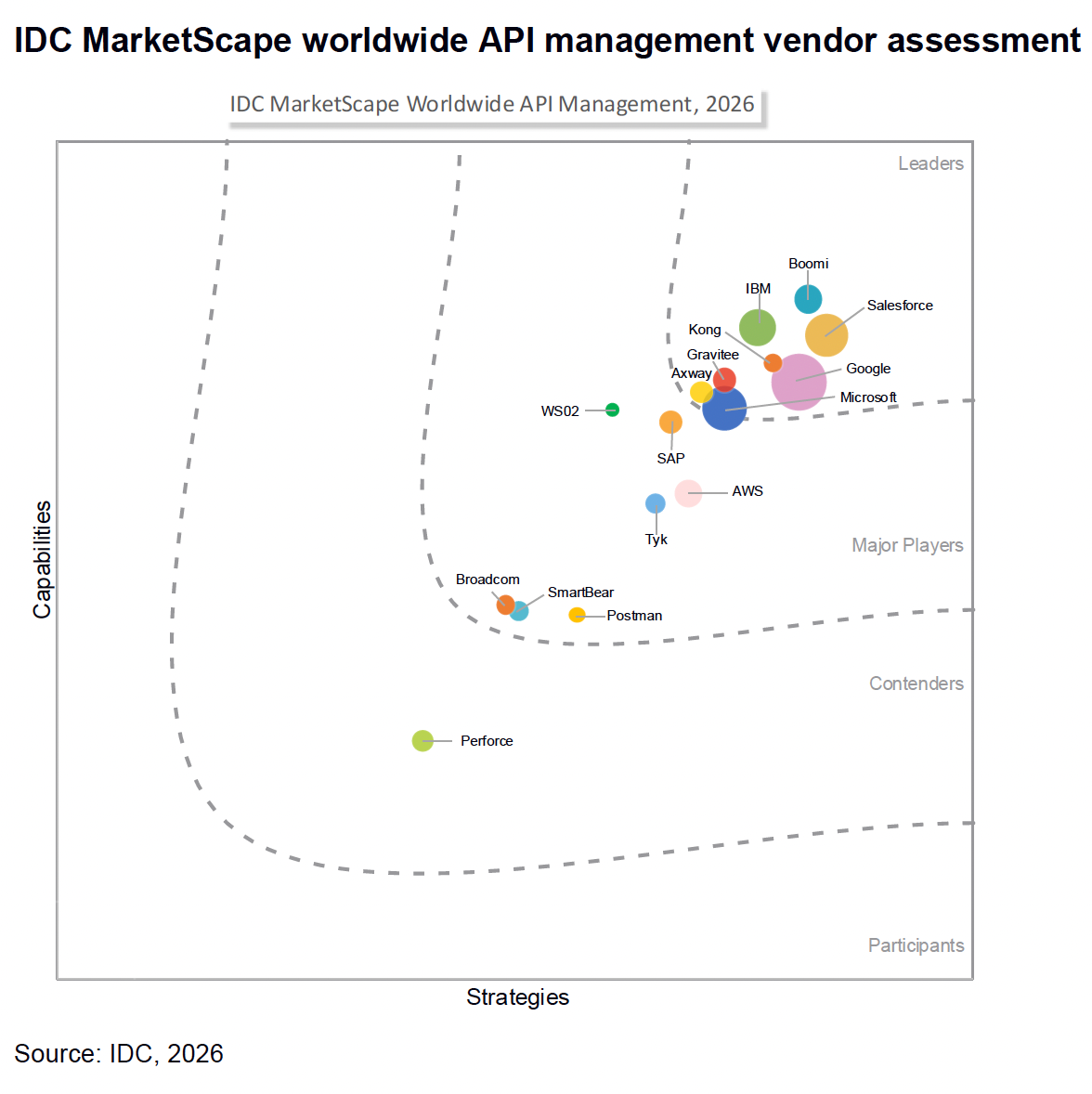
I’m incredibly proud to announce that IDC has named Boomi a Leader in the 2026 IDC MarketScape for Worldwide API Management. This is not the first time a major analyst firm has recognized Boomi as a Leader in this market, but what makes the IDC MarketScape particularly meaningful is its opinion and advice on where the API management market is headed, and we believe this recognition is validation that Boomi has the existing capabilities to address this shift and is strategically well-placed to continue to adapt.
The Market Has Fundamentally Changed
We believe that the IDC MarketScape research puts some striking numbers on a shift that practitioners already feel in their work. According to IDC’s June 2024 AI-Enhanced Connectivity Automation Survey, organizations investing in generative AI (GenAI) report nearly five times more APIs than those not pursuing GenAI. API sprawl, fragmented integration solutions, and a need for modernizing security and lifecycle management are driving a new breed of API management offerings.
The volume problem alone would be enough to drive demand for better API management. But there is something more important happening underneath it. The same APIs that power digital experiences and partner integrations are increasingly the interfaces through which AI agents, language models, and automated systems access enterprise data and take actions in the business. That shifts the stakes considerably. An API that is inconsistently governed or poorly observable is no longer just a technical liability — it is a barrier to AI that actually works.
What the IDC MarketScape Recognized About Boomi
The IDC MarketScape highlighted three things that I think speak directly to why Boomi is positioned well for this moment.
The first is what they called our integration-led foundation. Boomi’s API management doesn’t exist in isolation, it sits on top of a mature platform on which our customers have built critical business assets. This means teams can take existing integration flows, connectors, and orchestrated processes and expose them as well-governed APIs without rebuilding from scratch. For enterprises that are modernizing while managing complex, multi-system environments, that continuity is genuinely valuable. You are not starting over to get organized.
The second is what the IDC MarketScape described as our AI strategy. Their characterization here was precise, and we believe it reflects something we have been intentional about: a “dual focus on AI-assisted API development and API governance for AI access.” The first half is about using AI to make the API lifecycle faster and less manual, helping teams design, document, test, and iterate on APIs with less friction. The second half is about making sure that when AI agents and LLMs need to interact with enterprise systems, the APIs they consume are secure, governed, and trustworthy. Most vendors are doing one of those things. Boomi is doing both.
The third is our unified platform story. The IDC MarketScape described it as “Boomi’s vision for AI and automation emphasizes a unified platform where integration, APIs, data, and automation capabilities can be orchestrated together, and this vision is reflected in how the company positions its road map and product investments.” They also noted that Boomi is “quick to incorporate new AI standards and approaches into the platform,” which matters enormously when those standards are evolving as fast as they are right now. A platform that treats AI as a feature release will struggle to keep pace. A platform that is architecturally ready for it has a different kind of durability.
Why the Full Platform Matters
Here is the piece of IDC’s MarketScape analysis I want to spend a moment on, because I think it captures something important. In their guidance on when to consider Boomi, they specifically called out organizations that are actively planning to operationalize AI, especially those interested in building or orchestrating agents. Boomi’s combination of capabilities can help establish a “controlled API fabric” that feeds AI and automation use cases while maintaining governance, security, and lifecycle consistency across the broader application landscape.
That “controlled API fabric” describes something that point solutions, cloud-locked platforms, and standalone gateways cannot deliver on their own. The Boomi Enterprise Platform was built around a fundamental idea: enterprise data must be in motion to be useful. Having data that is static or siloed isn’t enough. To power AI, fuel automation, and support real-time decision making, data has to be connected, mobilized, and governed.
When your integration platform, your API management, your data management, and your agent development and management environment share a common control plane, the result is more than the sum of its parts. Your APIs become a governed activation layer for data, not just an interface. Your AI agents get access to enterprise systems through a managed, observable, policy-enforced channel. As the data activation company, we provide the architectural foundation that makes agentic AI real in the enterprise.
What Comes Next
We are moving quickly. The work we are doing around MCP enablement, expanded federation, agent connectivity, and embedded AI in the API lifecycle reflects a clear conviction: the future of API management is inseparable from the future of AI in the enterprise. We believe the IDC MarketScape recognition validates that direction. But more importantly, so do the customers and partners who are building on the Boomi platform today and trust us to help them navigate what comes next.
If you are evaluating where to invest in API management or thinking through how your API strategy connects to your AI strategy, I would encourage you to read the IDC MarketScape. It covers the strengths, the challenges, and the strategic considerations across all evaluated vendors with depth and candor. It is a useful framing for what comes next.
Download the IDC MarketScape excerpt here.
—
Graphic Source: March 2026, IDC #US52034025e