



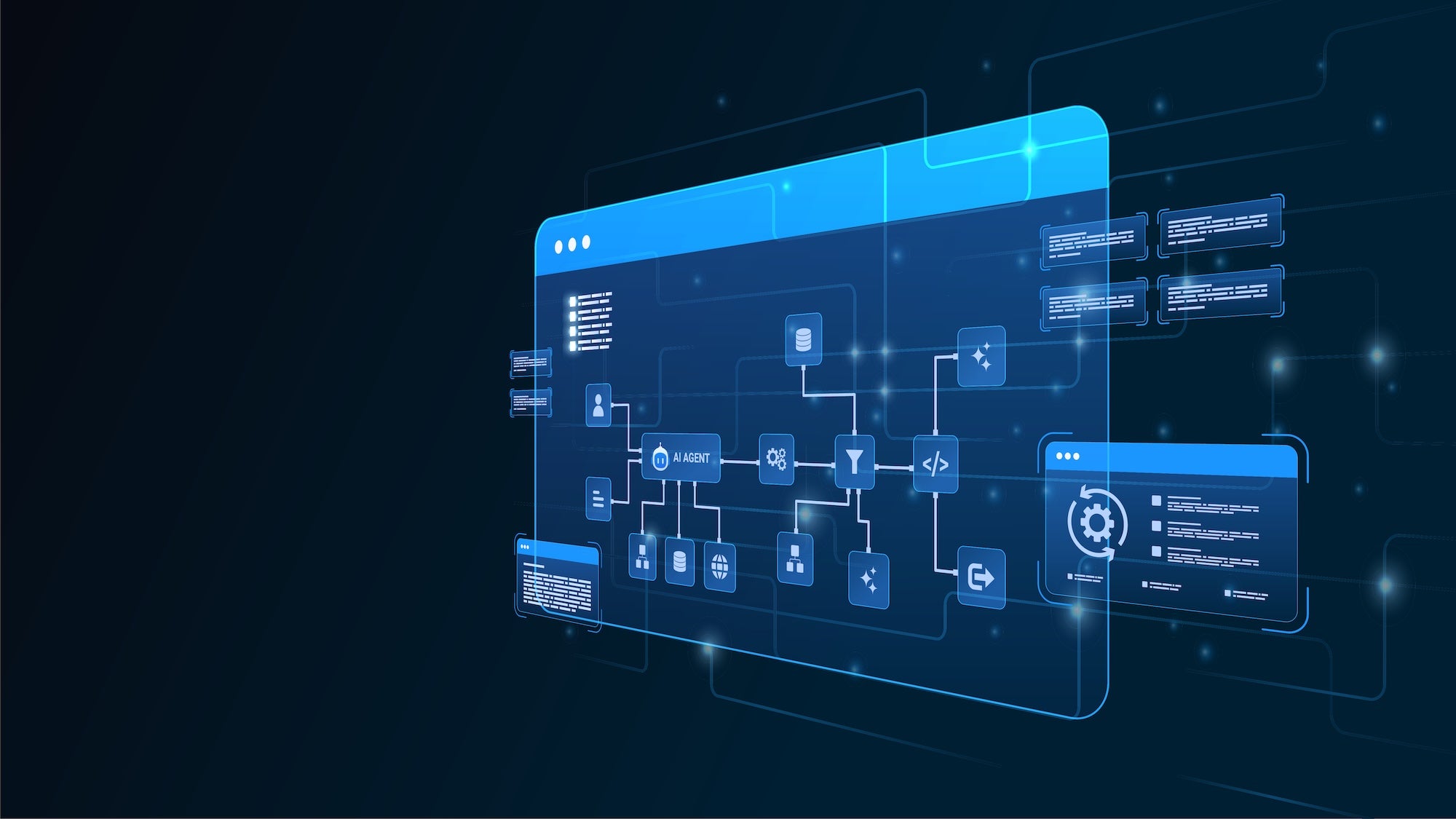
As AI agents reinvent how businesses operate, from automating customer service and streamlining financial processes to coordinating supply chains, there’s one thing many people overlook: none of it works without application programming interfaces. APIs are the digital sinew that allows agents to discover enterprise capabilities, exchange context, and take secure, auditable action. Every time an agent retrieves a customer record, triggers an order, or updates an ERP system, it’s making an API call.
And the area in scope is vast. Organizations investing heavily in GenAI-powered apps are running roughly 5x more APIs than those that aren’t. That explosion creates a paradox every technology leader now faces: you need to create APIs faster than ever to feed AI innovation, while simultaneously tightening the governance and security around them.
But AI agents aren’t only hungry new consumers of your APIs, they’re also becoming remarkably effective at enhancing API operations themselves. They streamline monitoring, documentation updates, security reviews, testing, and all the other essential but tedious work that most engineers would happily delegate if they could.
So, how do you get the best of both worlds? What are the most successful ways to make your APIs agent-friendly and take advantage of agents to boost your API management? Keep reading to find out how to put together a solid API management strategy to make everything work together seamlessly.
What Is API Management?
API management is the process of overseeing your APIs from creation to retirement — making sure they stay effective, secure, and aligned with your business goals throughout their lifecycle. In the modern SaaS ecosystem, APIs connect your applications, sync your data, and increasingly serve as the gateway through which AI agents interact with your most critical systems.
That said, an API management strategy shouldn’t be seen as just about monitoring infrastructure, but as enforcing a basic safeguard for AI. That’s because APIs are now more than technical connectors, they’re also decision engines that apply specific rules of engagement. For example, when an AI agent decides to pull customer data, make a payment, or edit a record, it’s the API layer that determines whether that action is authorized, logged, and compliant.
How AI Agents Depend on APIs
Imagine a restaurant run entirely by AI agents, a sort of “Bot Bistro,” if you will. The front-of-house agent takes your order and communicates it to the “chef” agent. That chef agent coordinates with other cooking agents for salads, appetizers, and desserts, while a separate agent brings you your meal and another manages payment processing. Every handoff is an API call. All of it is near-instantaneous.
While we don’t have a Bot Bistro just yet, this analogy maps directly to enterprise operations and how agents are increasingly performing tasks and collaborating on workflows. In business, agents access all the tools they use — web browsers, business applications, communication interfaces, and data processing capabilities — through APIs. They coordinate by claiming tasks from shared queues, reporting completion through callbacks, retrying failed operations, and synchronizing parallel work.
Model Context Protocol (MCP) is being adopted as the common interface for how agents find and use tools. Think of it as a sort of universal USB-C connector for AI — instead of building proprietary integrations for every system, MCP provides a single, standardized port that simplifies how agents discover and interact with available APIs, making it easy for them to take advantage of countless tools in a single environment. Other emerging standards, like ACP (Agent Communication Protocol) and Agent-to-Agent (A2A) protocol, are taking this further by letting agents communicate directly with each other through structured API calls.
Organizations that unify their data early are able to get more value out of their agentic transformation strategy. Learn more in “From System Failure to System Future“
Making Your APIs Ready for AI Agents
Unfortunately, most APIs were designed for experienced human developers who can read documentation, write integration code, and deploy things in a controlled sequence. But agents operate differently, reasoning through problems on the fly and deciding which endpoints to call based on immediately available context. A single user request like “rebook my trip and update my expense report” can trigger a cascade of API calls across multiple unrelated services, with the agent picking its own path as it goes. Nobody can hardcode that kind of workflow. This transition from pre-planned to improvised, context-driven interactions touches everything about how your APIs need to work. Let’s look at what needs to change:
Get Visibility to Prepare for Unpredictable Traffic
Before you can make good decisions about rate limits, routing, or safety guardrails, you need to understand how agents actually behave in your environment. Set up your APIs so you know what agents are calling, how often, in what patterns, and what’s failing.
That visibility is needed because agents change traffic dynamics completely. A single user prompt can trigger a web of parallel and sequential calls across multiple backend services. Traffic becomes erratic and hard to forecast, so throttling per user alone isn’t granular enough, you need limits per agent, per task, and potentially per individual workflow execution. The good news is that well-built agents can read rate-limit headers from your API responses and adjust their behavior accordingly. But they can only do this if your API actually sends those signals clearly.
Fix Your Auth Foundation and Build Security Around Limited Trust
With an AI agent, the direct connection between human intention and action gets blurry. If you tell an agent to “clean up my account,” it might interpret that as permission to delete records you wanted to keep. That possibility demands a security model built for autonomous decision-makers acting on behalf of someone who can’t review every action before it happens.
Start with OAuth providing time-limited tokens tied to specific permissions. Layer on two tiers of access control: broad scopes that limit which categories of endpoints an agent can reach, and narrow claims embedded in the token itself that enforce more specific restrictions. Set up separate trust levels for different types of agent clients, since a server-side agent that can protect its own credentials deserves different treatment than a public client that can’t store secrets securely.
For financial transactions, data deletion, contract modifications, and anything else with serious implications, call for direct human approval before the agent can proceed. And make sure your APIs can distinguish agent traffic from traditional application traffic by embedding that distinction in the token itself. That opens the door to tighter rate limits, mandatory confirmation for sensitive operations, and flagging all agent activity for audit review.
Make Your APIs Machine-Discoverable
Instead of every new connection requiring a developer to manually configure which endpoints an agent can access, standards like MCP give agents a structured way to ask “what can I do here?” and receive a machine-readable answer. This lets them figure out what tools are available, what parameters are required, and how to make proper calls without needing custom code for each new service.
The specific protocol matters less than the principle: your APIs need to describe themselves in ways that software can parse and act on independently. More broadly, that means standardized error handling, consistent response formats, and comprehensive metadata. APIs that follow RESTful or GraphQL best practices and are modular and reusable across different contexts will be far easier for agents to work with than bespoke, one-off interfaces.
Upgrade Your Gateways Incrementally
Traditional API gateways are essentially traffic cops, they verify credentials, route requests, apply rate limits, and write logs. But agents need routing that understands intent, not just destination URLs. The concept of an “Agent Gateway” adds a reasoning layer on top of traditional gateway functions, to work out which backend service best matches a request based on context rather than just the URL. You gain capabilities like caching based on semantic similarity, detecting and redacting personal data before it reaches a language model, and tracking token consumption for cost visibility.
The good news is that you don’t need to rip out your existing gateway. Start with monitoring, then layer in intelligent routing for selected use cases, then add data protection and safety filters. Each step teaches you something that makes the next step easier.
You should also think about synchronous versus asynchronous operations. Some agent tasks are blocking, but many others are fire-and-forget: kicking off a report, syncing a batch of records, processing uploaded files. Build both patterns in, and clearly document which endpoints go in which direction.
4 Steps to Putting AI Agents to Work on API Management
So now your APIs are ready for agents, you can flip the script and put agents to work managing the APIs instead of you.
Early adopters that have handed performance monitoring, documentation upkeep, test suites, incident response, and security policy tuning to agents report saving millions of dollars, boosting productivity by as much as 60%, and cutting incident response times from hours to minutes.
Here’s how to make sure your agents are proving their value:
1. Start With Test Automation
The traditional process of reading the spec, writing test code by hand, building request and response models, and creating validation queries is slow and labor-intensive.
AI agents can compress most of that work dramatically, accepting test descriptions in plain language, generating everything from test logic to data models, and producing a ready-to-review merge request without a human writing a single line of test code. Engineers can still review and approve, so you’re not running unvetted code. And when the cost of adding another test drops to near zero, teams can even start writing the tests that used to get deprioritized because nobody had time. If you’re looking for a low-risk, high-return entry point, this is it.
2. Hand Off Documentation
API documentation is something everyone agrees is important but nobody wants to own. It’s quickly out of date, usually incomplete, and always someone else’s problem.
AI agents fix this by analyzing API specifications and automatically generating comprehensive documentation in multiple formats. More importantly, they keep it current as APIs evolve, ensuring that what developers read actually matches what the API does today, not what it did six months ago.
Some teams are even experimenting with documentation that adapts based on actual usage patterns, adjusting examples to reflect how developers really interact with the API rather than how the original author assumed they would.
3. Add Always-On Security Monitoring
Roughly 92% of organizations have experienced API-related security incidents. This is partly because API security is traditionally a reactive game for most teams: something unusual appears in the logs, someone investigates, someone writes a new rule, and you hope the next attack follows a similar enough pattern to get caught.
But agents are faster than humans at pattern recognition across high-volume traffic, and they never take time off. They can identify patterns that would take human analysts hours to spot — unusual geographic clusters of requests, call sequences that look like vulnerability probing, authentication patterns matching known attack playbooks — and take immediate action while flagging it for human review. What’s more, compliance monitoring runs continuously and vulnerability patches can apply automatically.
4. Expand to Self-Healing, Traffic Management, and Lifecycle Governance
Agents can also take over broader operational concerns. Instead of a system that pages you at 3 a.m., what about one that fixes the problem and leaves you a detailed note to read in the morning?
For example, self-healing APIs continuously monitor response times, error rates, and throughput to catch degradation before users notice it. When something breaks, they diagnose root causes and take corrective action, maybe by restarting services, rerouting traffic, spinning up resources, before verifying that the fix actually worked.
On the traffic side, instead of backward-looking monitoring where an alert fires after users already feel the impact, agentic systems watch in real time, predict demand from historical patterns, and adjust resources on the fly. They optimize caching, adapt rate limits per user based on individual patterns and subscription tiers, and identify waste like duplicate calls, cacheable responses, low-priority traffic consuming peak-period resources. For teams with significant API consumption costs, especially those calling third-party services with usage-based pricing, these optimizations directly reduce spending.
Agents also tackle the API sprawl caused by developers building new APIs without realizing suitable ones already exist. Before generating a new API, an agent searches the current collection and surfaces matches, or, if nothing suitable turns up, it generates a spec, attaches documentation, validates against organizational standards, and creates test cases in a single workflow. It’s the kind of consistent governance every organization wants in theory but nobody has the bandwidth to enforce manually.
How Boomi Brings It All Together
The Boomi Enterprise Platform combines integration platform as a service (iPaaS) capabilities with advanced API management to enhance both sides of the AI-and-API equation with a single solution.
Boomi delivers:
- Unified API Management: No more governance silos thanks to a single control plane across multiple gateways and vendors. Consumption analytics highlight where you’re overspending, underperforming, or duplicating effort.
- AI-Powered Discovery and Intelligence: Automated tools find shadow APIs lurking in your network and bring them under governance. Boomi Suggest draws on 300 million+ integration processes to recommend optimal mappings and configurations.
- Intelligent Orchestration and Routing: A no-code workflow builder with AI-assisted design for multi-system processes. Predictive performance management catches bottlenecks before they hit your users.
- Agentic AI Tools and Controls: Agent Builder provides a low-code interface for designing agents with precisely defined access boundaries. Agentstudio monitors agent behavior in real time. Specialized agents handle API design, sensitive data, and troubleshooting, with support for custom agents.
- MCP Connectivity: Industry-standard Model Context Protocol support so agents can discover and interact with your enterprise systems out of the box.
- Federated Management: Govern APIs consistently across acquisitions, departments, and multi-vendor gateways — without forcing disruptive platform migrations.
Excited to get started? See how Boomi’s comprehensive API management strategy ensures your APIs are ready for AI agents.