






























Key Takeaways
- Boomi’s Flex runtime is a containerized, Kubernetes-based framework that lets you deploy and manage diverse AI, integration, and API workloads in a single self-hosted cluster without operational sprawl.
- Complete Data Control & Privacy: Sensitive enterprise data, logs, and agent execution histories remain entirely inside your local network runtime, ensuring complete data sovereignty and strict compliance.
- Seamless Scalability & Management: Features auto-scaling, self-healing, automated updates, and a centralized Runtime Management interface to easily enable and monitor Boomi workloads across your organization.
Over two decades ago, the rise of cloud computing changed the business application game. But as organizations raced to take advantage of software as a service, they quickly realized their now fractured data landscape needed to be stitched back together; these new cloud apps still needed to talk with the legacy systems powering their core operations.
To meet this need, the Boomi Enterprise Platform (then Boomi On Demand) was created, featuring its patented distributed integration runtime architecture: the Atom (now known simply as a Boomi runtime.) This enabled organizations to build and manage integrations centrally in the cloud but provided flexibility to deploy, run, and connect them securely wherever they needed: in the cloud, on-premises, or quite often, a bit of both.
Today, automating an enterprise has evolved beyond just integrations. Modern workloads span APIs, complex data pipelines, data quality, human-in-the-loop workflows, and eventing. And of course, AI agents. As organizations deploy intelligent agents, along with the orchestration, model gateways, and other supporting capabilities, maintaining strict data control, privacy, and residency remains critical.
To meet these new demands, we are introducing the Flex runtime: a cloud-native framework built to run and manage diverse, intelligent Boomi workloads in a unified cluster without operational sprawl.
Flex Runtime Architecture and How It Works
The Flex runtime is a containerized solution built on Kubernetes to harness native auto-scaling and self-healing. Deployable in public clouds, private clouds, or on-premises, Flex provides container-native resilience across all environments. It is designed as a generic framework that can install and run workloads from any of Boomi’s current or future services.
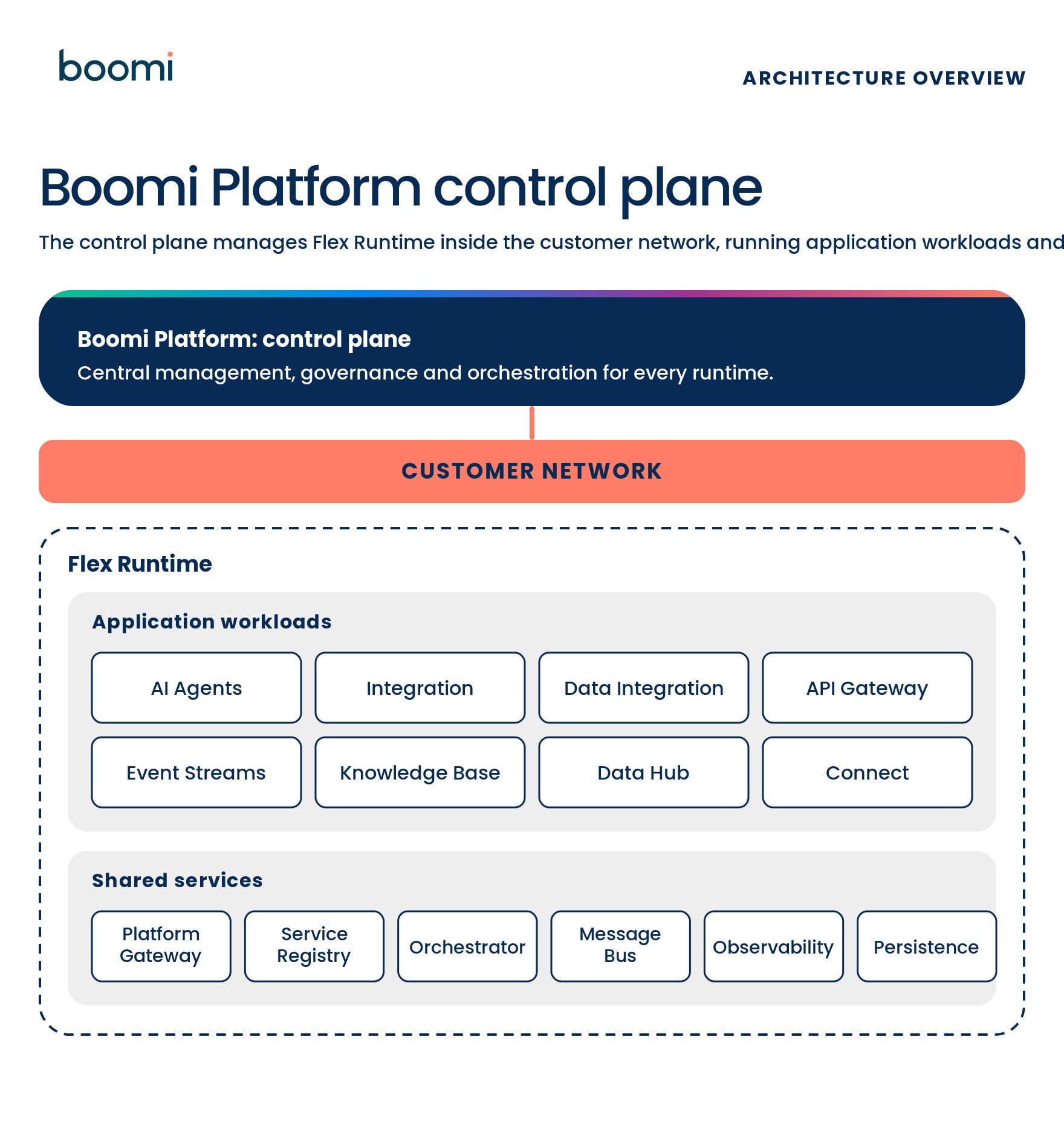
Boomi Platform Control Plane
For those experienced with the current integration runtime, many concepts will be familiar. Workloads execute independently from the Boomi platform, regularly checking in to provide status updates and executed job summaries, and to receive configuration changes, asset deployments, and new software releases.
Crucially, client data stays within your controlled network. The runtime processes data locally and connects directly to your endpoints. Your data is never processed through the Boomi platform. All potentially sensitive data, including payloads, logs, and agent histories, are persisted exclusively inside the local runtime environment.
Why Flex
The framework provides number of key benefits including:
- Support any Boomi workload in a self-hosted environment, starting first with agents
- Mix and match combinations of workloads across Flex runtimes
- Consistent runtime installation and management experience
- Enable Boomi workloads with a checkbox instead of an install
- Modern, cloud-native technologies for scale, resilience, and observability
- Self-healing and self-updating automatically
We are also introducing a new, unified Runtime Management interface. This is where you will create and manage Flex runtimes and their workloads. Over time, it will expand to include all existing service runtimes across your organization, so you will have a single, centralized management center to view and administer every runtime.
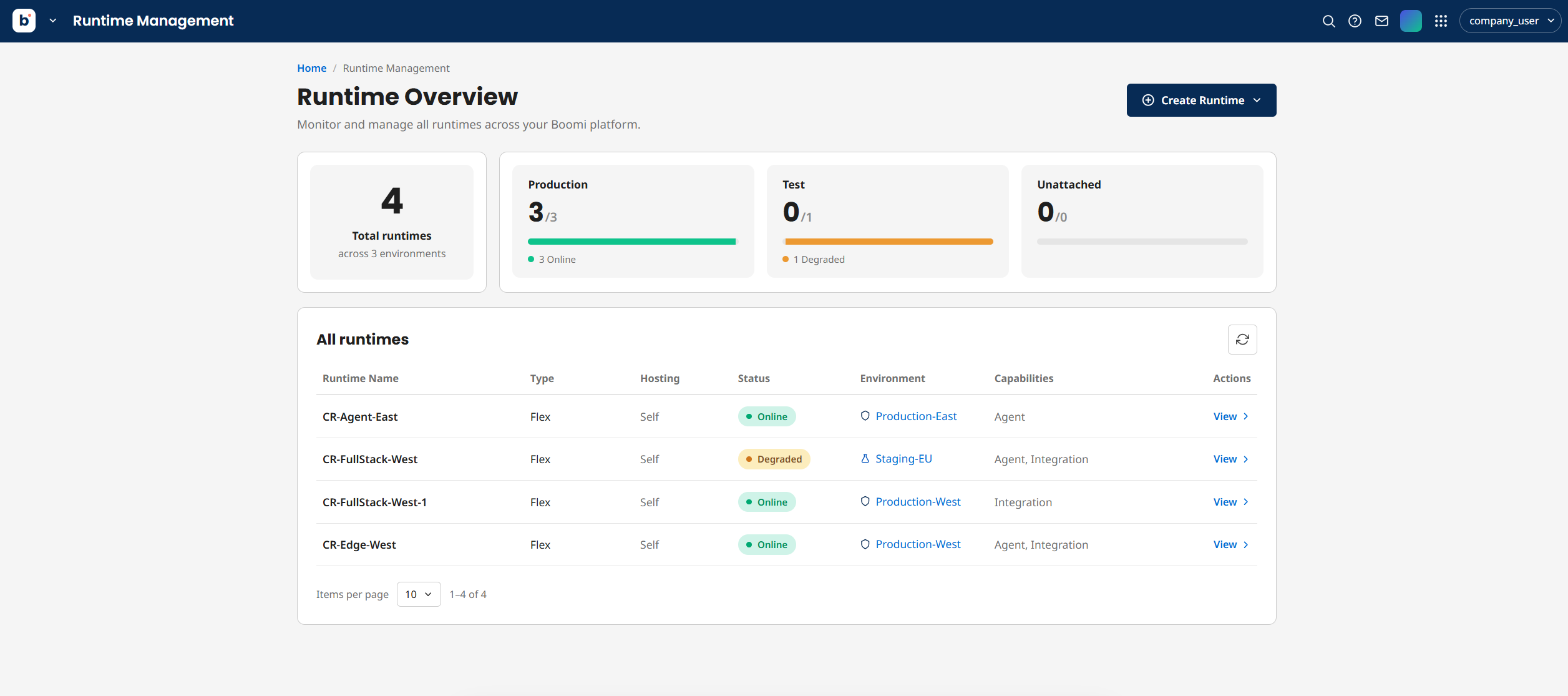
Boomi’s Runtime Management UI Overview
Installing a Flex Runtime
The high-level steps for installing a Flex runtime into your Kubernetes cluster are:
- Create a new Flex runtime definition within the Runtime Management UI.
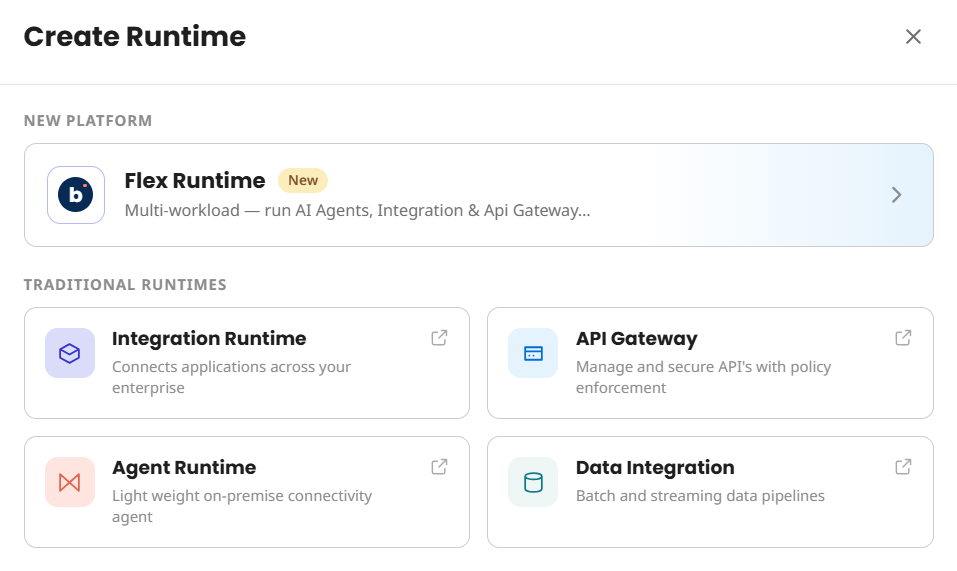
Creating a new Flex runtime definition within Boomi’s Runtime Management UI
- Install the runtime containers in your Kubernetes cluster using the Boomi runtimectl utility. The installer automatically downloads, configures, and starts the runtime’s core services.
- Back in the Runtime Management UI, select one or more Boomi workloads to enable for this runtime. The Flex runtime automatically downloads and configures the necessary containers for those workloads. You can add, remove, or modify workloads at any time.
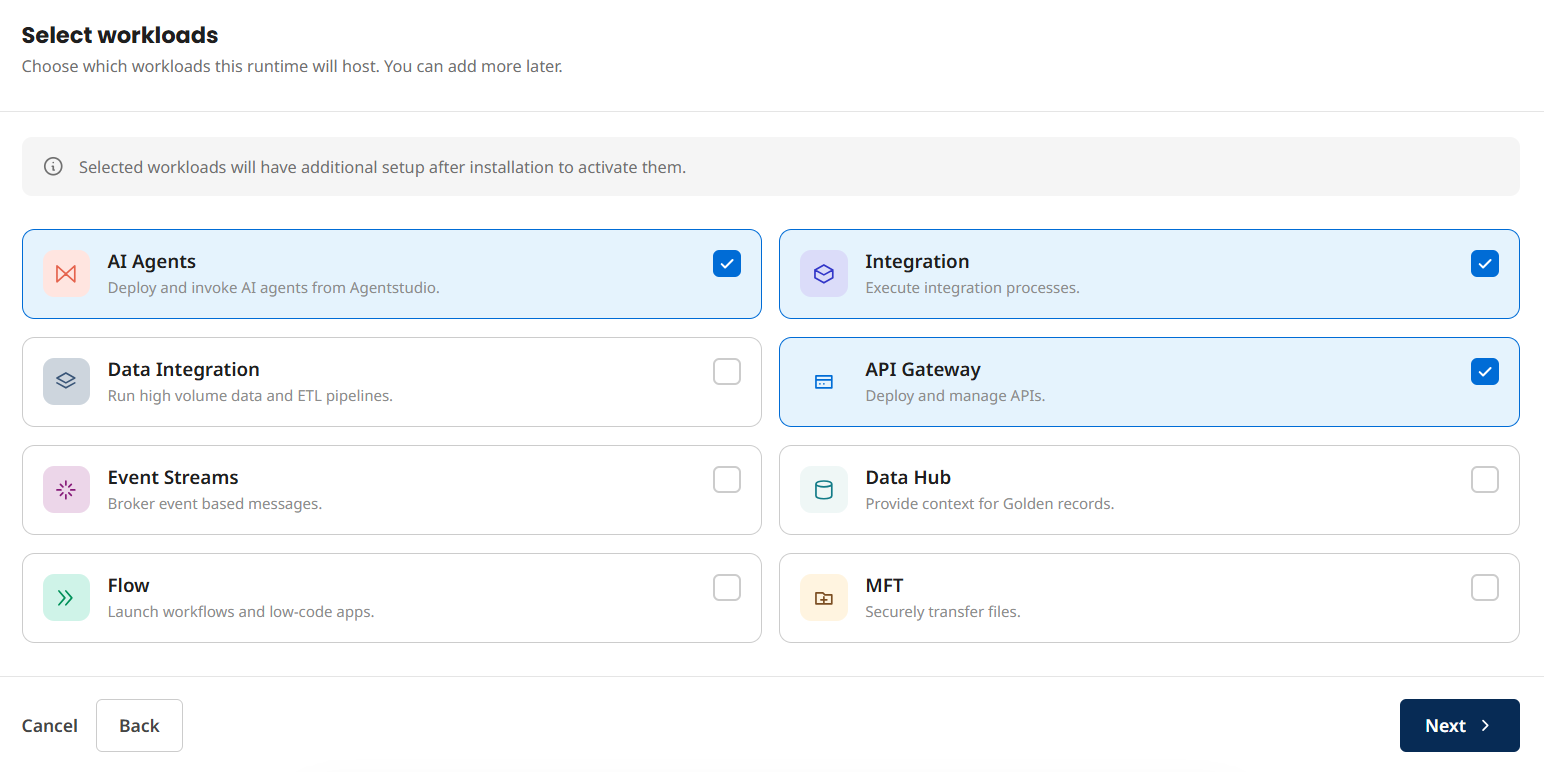
Selecting workloads within Boomi’s Runtime Management UI
- When complete, the Flex runtime shows as a target for deployments in the applicable Boomi services.
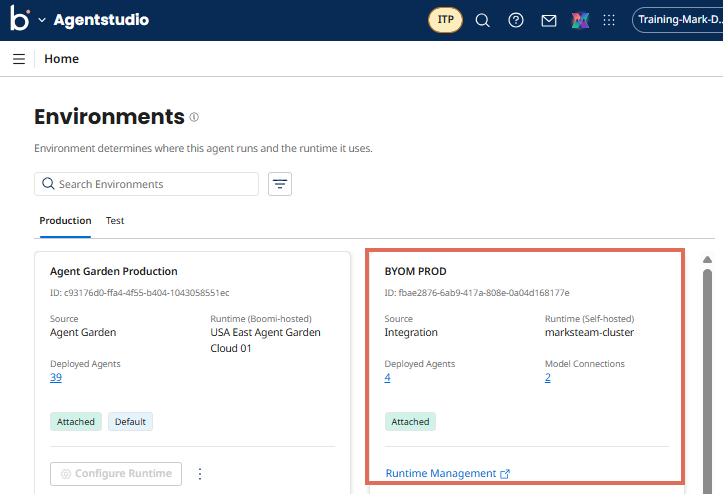
The Flex runtime shows as a target for deployments in the applicable Boomi services
Getting Started
The Flex runtime will be generally available in December 2026, starting with support for locally deployed AI agents built with Boomi Agentstudio. Support for additional Boomi workloads, including Integration, will follow in upcoming releases.
To learn more about the Flex runtime, visit the documentation and get started.