



This article contains forward-looking statements based on current expectations, forecasts, and assumptions that involve risks and uncertainties. As such, the dates and deliverables represented cannot be guaranteed and should not be viewed as commitments.
This article recaps the Boomi Product Roadmap webinar and highlights some of the recently delivered product features and the upcoming roadmap.
We are looking for your feedback! Do you have ideas on how we can improve future product roadmap webinars? Take our brief survey.
Boomi Overview
Our 2026 roadmap mission continues to be focused on:
- True Freedom: We pride ourselves on being open and neutral without vendor lock-in.
- Time-to-Value: Our solutions help you build quickly, deliver at scale, and ultimately accelerate your business outcomes.
- Being Customer Obsessed: We listen to our customers and collaborate with them on how we can make our products better. When our customers win, we win.
- Innovation: Whether it’s new AI capabilities or a new approach to an old problem, we constantly push the boundaries of what iPaaS is, each and every month in our product releases.
Looking for ways to engage with us?
Check out our Early Access Programs to try new features before they are generally available. This is a great way to collaborate with our team and influence the future of the Boomi platform.
Have ideas on how we can improve the product?
Check out our Community Product Feedback Forum to share your ideas on how we can make Boomi better. Our product team reviews all feedback and takes it into consideration during our roadmap planning process. More information can be found here.
Below are the service-specific roadmaps and recent delivery highlights. Thank you for your continued support and partnership.
Owen Friedrich – VP of Product, AI & Integration
—
Boomi AI
Agentstudio is moving from foundation to scale. Recent releases deliver programmatic agent management via public APIs, multi-region runtimes for data residency compliance, and live plan streaming that makes agent reasoning observable. The July release includes file uploads for document-centric workflows and Meta Hub and Knowledge Hub integration to ground agents in governed enterprise knowledge. On the roadmap, we have BYOM with flexible runtime deployment for data sovereignty, agent SDLC, multi-agent orchestration, and auto-registration with real-time anomaly detection to bring software engineering discipline, collaborative agent workflows, and governance that scales as agent counts grow.
Recent Delivery Highlights
- Agent Garden APIs: Programmatically create, configure, deploy, and manage agents without touching the Boomi UI.
- Multi-Region Deployment: Deploy agents to USA East, UK, Japan, or Australia runtimes to meet data residency requirements.
- Cross-Region Visibility: Agent Control Tower provides a unified view across all regional agent deployments and runtimes.
- Real-Time Plan Streaming: Watch agents reason live during Extended Thinking conversations instead of a static loading message.
- Session-Scoped Memory: Agents remember previous tool responses across a session, reducing redundant calls and improving reasoning.
- MCP Registry: Centralized hub governing which MCP servers your organization can use, bridging API Control Plane and Agentstudio.
- Claude Code Telemetry: Ingest Claude Code token usage, cost, and active time metrics directly into Agent Control Tower.
Up Next
- File Uploads: Unlock new classes of agentic workflows, such as document extraction with OCR, data analysis, etc. with file uploads
- Meta Hub Glossaries: Attach business glossaries to agents at design time for consistent, enterprise-aligned responses.
- Knowledge Hub Integration: Ground agent responses in governed enterprise knowledge, reducing hallucinations and improving accuracy.
- BYOM: Bring your own models for better control, performance and data sovereignty
- Agents in Runtime: Deploy agents to cloud, on-premises, or hybrid runtimes for better control, performance and data sovereignty.
- Agent SDLC and Model Routing Enhance: Agent versioning, testing and evals and AI Gateway and SLM pipeline support.
- Agents in Runtime and Solutions Builder: Deploy agents to your hosted runtimes and monitor; Generate solution blueprints and build individual assets comprising the solution.
- Agent Monitoring and Governance: Autoregister, monitor and govern boomi agents in real time.
- Multi-agent Orchestration: Build solutions that involve multiagent interactions to accomplish complex workflows.
—
Integration
Heading into Q3 2026, Boomi Integration continues its investment in enterprise governance and platform scale.
Recent Delivery Highlights
- Global Variables Archive and Unarchive in the UI (July): You can now archive and unarchive Global Variables directly from the Global Variables Management page, alongside the existing API support. A new “Archived” status column and an information-panel banner make retired variables easy to identify and protect from inadvertent edits, giving administrators the visual controls needed to manage variable lifecycle at scale.
- Integration Pack Release Experience (July): The Integration Pack release workflow is now more visible and trackable. The release progress indicator on the Integration Packs page is available to all accounts, with easier navigation during in-flight releases and timestamps recorded for every successful or failed release event.
Up Next
- Workspaces Early Access: A major new capability arriving in Q3, Workspaces gives enterprise teams multi-workspace organization with role-based access control over Integration assets. Large organizations get the operational separation they need across teams, projects, or business units without fragmenting their accounts.
- Runtime Selection in Agent Step: A persistent runtime selector is coming to the Agent Step configuration panel, letting developers browse and pick agents registered to any runtime, including private clouds and on-prem atoms. Customers whose agents live outside the public cloud can finally use Agent Step against them.
- Higher Profile Node Limits: The profile node limit is being raised from 5,000 to 10,000 for all accounts, applied uniformly to both XML and JSON profile imports. Large XSD imports, JSON schemas from REST and HTTP connectors, and OpenAPI specifications will now fit inside a single profile without silent truncation.
Want to try Workspaces in early access when it becomes available? Sign ups will open soon, keep an eye out on our Early Access Programs to be one of the first to sign up.
—
Managed File Transfer
Heading into Q3 2026, the Managed File Transfer roadmap is focused on security, compliance, and governance for regulated enterprises. We are closing authentication gaps to inbound SFTP endpoints, adding antivirus scanning to MFT Runtime, and delivering immutable, tamper-proof audit logging. Alongside these, endpoint metadata tagging adds data-sensitivity classification and richer observability, and a new Node-level external command execution engine opens the runtime to custom post-download processing. We are also shipping a re-architected Boomi MFT connector for more efficient, reliable and traceable file transfer to/from Boomi processes.
Recent Delivery Highlights
- Per-Tenant Compute Resource Quotas Enforcement: Multi-tenant MFT now enforces per-tenant limits on compute-intensive work to ensure that a single high-volume tenant can not consume all resources. Fair-share scheduling with configurable default quotas and tenant-specific overrides by plan/tier keeps throughput and latency predictable across the platform.
Up Next
- Multi-Factor Authentication for Internal SFTP (Password + SSH Key): SFTP endpoints where MFT acts as the server receiving inbound connections will gain a new authentication mode that requires both a valid SSH key and a valid password. This lets regulated customers in financial services, healthcare, and the public sector meet MFA-on-SFTP mandates.
- Endpoint Metadata Tags for Data Sensitivity and Governance: Customers will be able to stamp arbitrary name/value tags such as encryption=pgp or dataclass=pii on AFT Flow Endpoints through both the Management APIs and the Flow Studio UI. Tags propagate to the Activity API, screens and logs for every file processed, so teams can slice file-transfer telemetry by business context and correlate MFT activity with downstream data processing systems.
- Antivirus Scanning on the Windows MFT Runtime with Control-Plane Reporting: Windows MFT Runtime will integrate with Windows Defender to scan file content during transfer, holding each file until a result is returned and reporting a specific scanning status: passed/quarantined/error, back to the cloud control plane. This closes a long-standing observability blind spot where OS-level quarantine surfaced only as a generic “file not found” error, and it satisfies “double AV scan” compliance standards as required by high-security customers.
- MFT Runtime Post-Download External Command Execution: As the first phase of the broader MFT Runtime pre/post-transfer processing feature, MFT Runtime will be able to run an external command or script on each file after download from the MFT cloud and before it is moved to the target endpoint. This new execution engine supports Windows and Linux, concurrency, and configurable policies. Outcomes recorded in File Activity can raise alerts, and unlock use cases like local scanning by 3rd party antivirus, decryption, and proprietary file processing on the customer LAN.
- Next Gen Boomi MFT Connector (V1): First release of a fully re-architected, SDK-native connector for faster, more reliable file and metadata transfer in Boomi processes. Highlights:
- Multi-file processing: Lists and downloads all waiting files as separate documents in one execution, no more custom while-loops, no high-volume bottleneck.
- Native Start Shape: Use Get directly as a Start Shape, with Process Reporting to replay and reprocess individual files.
- Large files: Spills GB-scale files to disk instead of memory to avoid out-of-memory errors; auto-chunks uploads over 100 MB.
- OAuth 2.0: Every transfer authenticated with OAuth 2.0, with per-environment credentials via Environment Extensions for secure dev/QA/prod promotion.
- Rich metadata: Tracks file name, size, source, protocol, tenant/customer IDs, and uploader identity for branching, audit, and end-to-end traceability.
B2B/EDI Management
Heading into Q3 2026, Boomi B2B/EDI continues its investment in expanding Trading Partner connectivity, streamlining common EDI configurations, and supporting regional compliance mandates.
Recent Delivery Highlights
- SFTP Communication Method in the Trading Partner Framework (May): The May release started the unification of Trading Partner communication methods with the connector library used across the rest of Boomi, beginning with SFTP. The SFTP communication method now provides the same capabilities you already use in Integration processes, closing a long-standing gap between EDI exchange configuration and the rest of the platform.
- Segment Names in EDIFACT and X12 Acknowledgment Reports (July): Acknowledgment reports for EDIFACT and X12 now include segment names alongside element references, so EDI administrators can locate data element errors without cross-referencing the underlying specification. This reduces time to resolution on partner exceptions, particularly for teams managing high EDI volumes across multiple standards.
- Trading Partner Management Enhancements (July): The Trading Partner Management page now displays ISA and GS IDs in sortable columns for identifying duplicate trading partners across branches, and the search filter has been expanded with Organization, Standard, Interchange ID, Group ID, and Protocol so you can find the right partner in long lists with fewer clicks.
Up Next
- JMS Communication Method in the Trading Partner Framework: JMSv2 is the next protocol arriving in the Trading Partner framework, continuing the unification with Boomi’s connector library that began with SFTP. This closes the gap for customers using JMS-based messaging like IBM MQ or ActiveMQ for B2B document exchange, with modern JMSv2 capabilities such as shared subscriptions and durable topics.
- Multi-Standard EDI Inbound on a Single AS2 Identifier: Trading Partner setups will support receiving multiple EDI standards, such as X12 and EDIFACT, from multiple partners through a single shared AS2 identifier, aligning with the standard VAN pattern of using one AS2 identifier for all inbound data.
PEPPOL Compliance via the Boomi EDI VAN: European customers facing PEPPOL e-invoicing mandates get a supported, documented path to compliance through the Boomi EDI VAN partnership with ECGrid, delivering full PEPPOL network connectivity as a documented, repeatable Boomi offering.
Integration Runtime
In this quarter we’re continuing to introduce additional observability and management capabilities to help you operate your integration runtimes at scale, especially for real time and event based integrations.
Recent Delivery Highlights
- Observability for Cloud Attachments: Runtime cloud owners can allow attachments to configure and export their own telemetry data (link) to endpoints of their choosing. This is also available for customers using Boomi’s Managed and Dedicated Cloud Services.
- Runtime Management APIs: We’ve delivered the last of a suite of runtime management APIs, with the ability to configure forked JVM settings. These APIs allow customers and partners to automate the provisioning and configuration of runtimes. See runtime API reference.
Coming in July
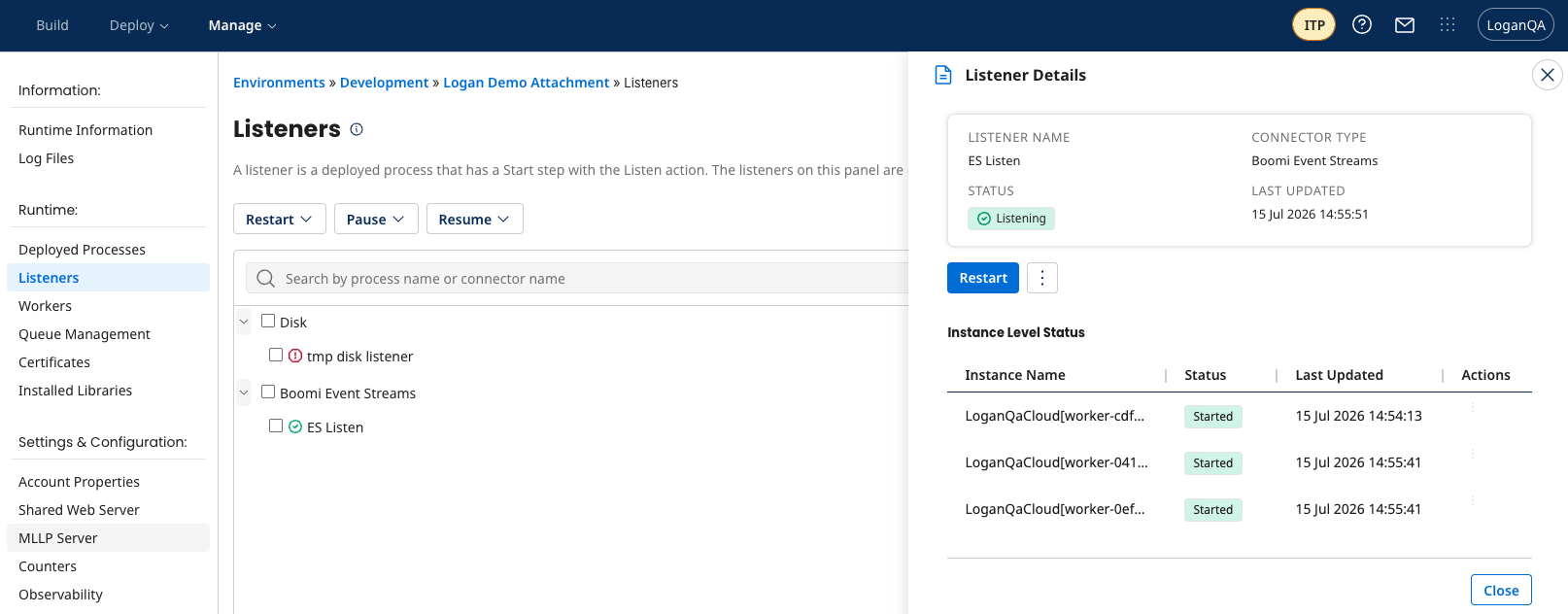
- Listener Status Detail: The Listener Status page has been overhauled to provide more granular status for integration process listeners, so you can better understand and troubleshoot real time integrations. This includes drilling down to see each instance of a listener (across cluster nodes and workers) as well as operational status after startup (varies by connector). Learn More
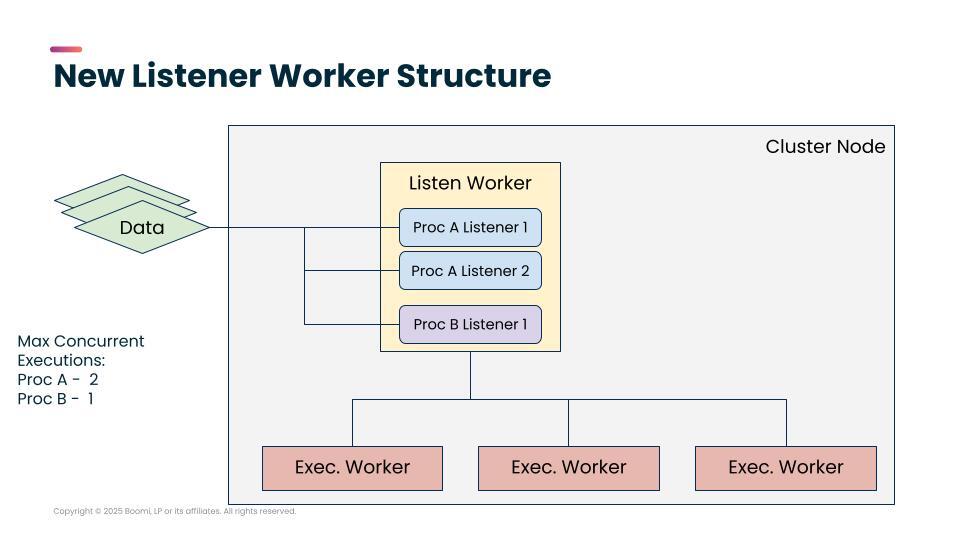
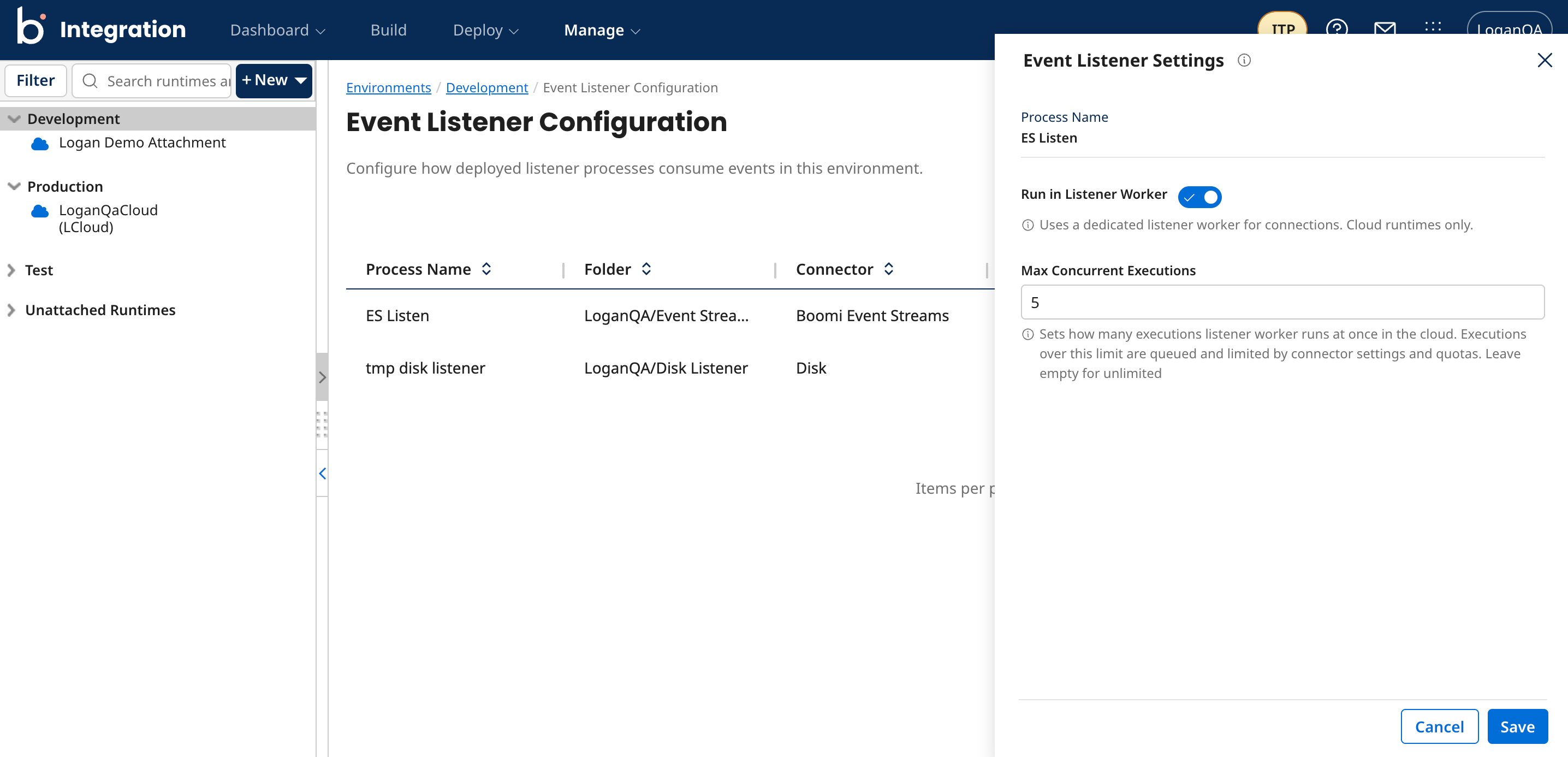
- Listener Worker – We’re introducing a new type of specialized worker in runtime clouds to manage the listener connections for event based integrations such as Event Streams, Kafka, and Solace. This new worker operates in conjunction with existing execution workers to govern cluster-wide concurrency and enable elastic scaling for those types of integrations. Learn more.
Up Next
- OpenTelemetry Distributed Tracing: Preserve trace IDs for incoming web service calls to maintain context with upstream actions.
- OpenShift Support: Official support for deploying containerized and elastic integration runtimes on the OpenShift platform.
- Environment Extension Optimizations: Improve performance of applying extension updates to listener processes.
Connectivity
In this quarter, the connector roadmap picks up more momentum — new connectors filling gaps that customers have been asking about for years, deeper enterprise capabilities on the connectors they depend on most, and a platform layer built for AI-native connectivity.
Recent Delivery Highlights
Our recent connector enhancements focus on strengthening security, performance, and operational efficiency across the ecosystem:
- NetSuite REST Connector: Now generally available (July release) with an expanded set of operations for integrations with NetSuite.
- Google BigQuery: New Write operation using gRPC-based Storage Write API, enabling immediate data availability for querying and DML after ingestion.
- Kafka: Support for Confluent Wire Format and AVRO complex type.
- Microsoft Azure Service Bus: New AMQP Send operation for sending messages via AMQP to both session-aware and non-session-aware queues and topics.
- Security & Authentication: Extended OAuth 2.0 Client Credentials support to both Salesforce and Salesforce Apex connectors. API Key authentication support in REST client connector.
- Dynamic Listener Status Reporting: Both Salesforce Platform Events and JMS v2 listen operations will report current real-time status back to the platform.
Up Next
- New Connectors: SharePoint, GraphQL, and Windows SMB connectors. Enterprise versions of Snowflake and Kafka connectors.
- MCP Server Connector: Reaching General Availability.
- Connector Enhancements:
- Azure Entra client certificate-based authentication in Azure connectors
- Support for dynamic listener status reporting in all listener connectors
- MongoDB – Native partial update operation
- Snowflake – Native support for upsert operation
Connect
We’re excited to announce and release Connect, a new Boomi product: a managed MCP connector service that gives any AI tool (Claude, Copilot, Gemini etc..) instant, governed access to enterprise applications like Salesforce, SAP, and Workday, with no custom integration work. It solves what stalls most AI pilots: agents can draft and summarize, but hit a wall when they need to pull data from or act in real business systems, and IT has no safe way to grant that access. Connect adds a governance layer between AI and the enterprise, with granular access control, identity-based mapping through existing IdPs, zero-touch credentials, and audit-ready logging of every tool call.
Recent Delivery Highlights
- Support for 500+ connectors and 10,000+ tools across enterprise applications.
- Enterprise data access secured by the user’s IDP identity, with permissions inherited automatically at both the connector and user level.
- Granular, tool-level access control — target different user groups within a single system (like Salesforce) using distinct permission sets tied to IDP roles.
Up Next
- New connectors: ADP, Gainsight, Loopio, Jive, and more.
- An observability dashboard for real-time tool usage monitoring.
- Support for integration connectors within Connect.
- Expanded MCP gateway controls, including policy enforcement and usage rate limiting.
Event Streams
As we move into Q3 2026, the Event Streams roadmap is built on three core pillars: Extensibility, expanding how applications connect to and consume event data beyond the native connector; Reliability, giving teams more control over error handling and message delivery guarantees; and Observability, improving visibility and control over active integration listeners.
Recent Delivery Highlights
Q2 was a productive quarter for Event Streams, with continued investment in usability and a major new capability now in customers’ hands.
- Dynamic Topic Routing with Filtering shipped in Q2, giving users the ability to define metadata-based filtering rules that route messages to specific topics automatically. This reduces unnecessary message processing downstream and gives teams precise control over which consumers see which data. Users can create, enable, disable, and delete routing rules directly from the Event Streams UI.
- UI consistency improvements across Topics, Subscriptions, and Token Management landed earlier this quarter. Unified table styles, clearer action icons, consistent timestamp formatting, and improved empty-state messaging make day-to-day operations noticeably smoother. Read-only users also gained message viewing access as part of this update.
Up Next
- Consumption REST API: We are introducing a REST API for direct, real-time message consumption, removing the dependency on the Boomi Event Streams connector and opening the door for any application to pull messages over standard HTTP. This supports integration patterns that don’t fit the connector model and makes Event Streams accessible to a broader set of consumers across any tech stack.
- Connector Listener Management Enhancements: We are adding listener management controls directly to the Event Streams connector, giving integration developers more visibility and control over active listeners without leaving the platform. This reduces the need to context-switch during troubleshooting and operations.
- Failure Routing for Exclusive Subscriptions: Today, exclusive subscriptions with transacted acknowledgment can get stuck in an infinite retry loop when a message fails to process. We are introducing the ability to configure a fallback/default topic for failed messages. Once a message exhausts its configured retries, it is moved to that topic automatically and processing continues with the next message in the queue. This prevents stuck consumers and gives teams a reliable way to capture and inspect failed messages without manual intervention.
Have a feature idea or use case we should know about? Submit it through the Product Feedback Forum. Stay tuned for more updates as we continue to build the most robust event streaming capabilities in the integration platform space!
API Management
—
Data Hub
In Q3 2026, the Data Hub roadmap shifts from building the governed foundation to activating it. Golden records are unifying across systems — with real-time delivery for critical operations taking shape in early access, and now flowing natively into analytics environments through Boomi Data Integration. This quarter we are focused on making governed records accessible to any AI tool or agent, grounding stewardship decisions in richer semantic context, and beginning to lay the groundwork for sovereignty so governance operates wherever your data must reside.
Recent Delivery Highlights
- Repository API Reference: The Data Hub Repository API OpenAPI specification is now available for download, giving customer developers a complete, explorable reference for building against Data Hub’s REST APIs across both the data modeling and data operations layers.
- Golden Record Query and Profiling APIs: The Query End-Dated Golden Records endpoint now supports filtering and optional metadata fields, bringing it to parity with Query Golden Records. Golden record profiling statistics are also now retrievable via API, with up to 60 days of historical data for tracking quality trends over time.
- Platform Reliability: We continued hardening reliability for high-volume and enterprise-scale deployments, addressing edge cases in batch processing and reference field handling.
- Real-Time Delivery Mode (Early Access): This capability continues to mature in early access – evolving as both an event-driven delivery channel for specific critical operations and a growing foundation for Boomi Data Integration orchestration, enabling golden record changes to flow in real time into downstream pipelines and analytical targets.
Coming in July
- UK Platform Support: The Data Hub connector now includes the UK platform cloud in its connection options, enabling organizations with data residency requirements to connect to Data Hub repositories hosted on the UK platform. This is part of a broader push toward giving customers governance where their data must reside.
- Real-Time Delivery Hardening: Audit log entries for delivery channel actions now accurately reflect what happened, closing a gap where pause and resume events were either logged incorrectly or not at all. Data Hub also now rejects model deployments that attempt to change a source’s output type between batch and real-time delivery, preventing configurations from landing in a broken state with no visibility.
Up Next
- MCP Server for Data Hub: We are advancing MCP server support, making governed access to both data models and golden records available to any AI tool or agent through a standard protocol. This extends the ability to reason against your trusted data layer beyond Boomi-native surfaces into the broader set of AI tools your teams already use.
- Augmented Stewardship: AI-guided entity resolution is coming, grounding match and merge decisions in the semantic context and lineage that Meta Hub provides, rather than relying solely on technical matching rules. As we modernize the core stewardship experience, Meta Hub plays an increasingly central role as an augmentation layer – bringing configuration lineage and governed metadata context across the data landscape so that stewardship decisions carry full business meaning, not just technical signal.
- Sovereign Deployment: We are working toward governance that can operate where your data must reside — across registry, consolidation, and federated models. For organizations with data sovereignty requirements, this is the path toward trusted data without geographic constraints.
- Data Quality Scorecards: We are building toward transparent, measurable trust scores at the record and domain level, giving stewards and operators a clear signal on data quality rather than requiring them to infer it from exception queues and error counts.
Apply for Early Access – boomi.to/earlyaccess
Data Hub Real-Time Delivery Mode is available in Early Access for teams with time-sensitive golden record delivery requirements. Questions or use cases? Connect with us in the Boomi Community.
Meta Hub
Boomi Meta Hub is the context engineering layer that grounds AI agents in the business meaning your organization already has but struggles to surface consistently. As Meta Hub advances through Expanded Early Access in Q3 2026, the focus shifts from establishing the foundation to deepening the connections between endorsed business definitions and the agents, integrations, and data assets that depend on them.
Recent Delivery Highlights
- Business Glossaries and Expert Endorsement: Meta Hub’s core semantic capabilities are live in Early Access. Organizations can now define rich, document-like business definitions for the terms that run their business, and domain experts can formally endorse those definitions as the organization’s source of truth. When a retention agent needs to know what “at risk” means in your company’s specific context, this is where that definition lives — not inferred from generic training data, but endorsed by the people who own the outcome.
Coming in July
- Business Glossaries – Broader Availability: With the July release, Business Glossaries is available to a wider audience of Boomi platform customers – and Meta Hub gains formal release notes and API documentation. For teams that have been watching from the sideline, this is a good moment to engage.
- Agentstudio Integration: Endorsed glossary terms can now be attached to agents directly inside Agentstudio, making business context defined by your domain experts available at agent runtime. This is the first in a series of cross-service integrations that will bring Meta Hub’s semantic layer to where work actually happens across the Boomi platform.
Up Next
- Data Lineage (Early Access): We are targeting Early Access for data lineage later this quarter — building the foundational services that trace data origins, transformations, and consumption across the platform. A key unlock is the bridge between business glossaries and technical data assets: when semantic context connects to the schemas and data flows it describes, the map becomes meaningful to both teams and agents in ways that pure technical lineage cannot.
- MCP Server for Meta Hub: We are advancing MCP server support, making governed semantic context available to any MCP-compatible AI tool or agent, not just those running inside Agentstudio. Your organization’s endorsed business vocabulary becomes a standard, discoverable context layer across the full ecosystem of AI tooling your teams use.
- Semantic Linking Across Boomi Services: We are building toward a governed semantic graph that connects your business vocabulary to integrations, data models, and knowledge entities across the Boomi platform, so context is not siloed by product but shared wherever Boomi operates.
- Semantic Advisor: Lineage and semantic context will be surfaced progressively across the Boomi development experience, making the business meaning of a data asset visible where builders are working, not just inside the governance layer.
Join Meta Hub – Expanded Early Access – boomi.to/earlyaccess
Are you ready to ground your agents in business reality? Meta Hub is in Expanded Early Access and your feedback is shaping what gets built next. Connect with the early access community in the Boomi Community.
—
Data Integration
Boomi Data Integration continues to expand its connector ecosystem, deepen AI-powered tooling, and bring more data sources natively into the platform.
Recent Delivery Highlights
- Data Hub Integration — Data Hub as a Source: Pull golden records out of Boomi Data Hub and land them in any warehouse natively. Setup is automated: no manual table structures, no loading config. Supports full load, incremental, and CDC mode, so you can run scheduled syncs or capture changes as they happen in your master data.
- Microsoft SharePoint as a Source: Connect SharePoint as a native source and load files directly into your warehouse or data lake (Snowflake, Azure SQL, Redshift, BigQuery, S3, and more), supporting CSV, Excel, JSON Lines, and other file types. Run full loads or incremental sync to keep pipeline runs efficient as your SharePoint content grows.
- Microsoft OneLake as a Target: Native support for Microsoft OneLake as a data target, letting teams load data directly into Microsoft’s unified data lake layer. Use all existing source connections and orchestration to load data as Delta tables in OneLake, immediately queryable with SQL and ready for Power BI reports.
- Snowflake as a Target — Merge Loading, Performance, and Lower Privilege Requirements: A significant performance improvement for Snowflake pipelines. The target now supports upsert semantics via native Merge — no table recreation, no switch-merge fallback — preserving Time Travel history. SYSADMIN dependencies have been eliminated, making deployments simpler in security-conscious environments.
- Data Connector Agent — Multi-Reports: A single configuration now generates multiple independent reports, cutting setup time for complex extraction workflows. This release also adds OAuth2 Password Credentials and JWT Bearer auth support, plus a new Epoch Date Format control to prevent ingestion errors in strict-schema targets.
- AI Assistance for Troubleshooting: A new Troubleshooting Agent explains pipeline errors in plain language and walks teams through step-by-step resolution. Instead of digging through logs, users get contextual diagnostics and actionable recommendations directly in the product, shortening time to resolution and reducing reliance on external support.
Up Next
- Data Hub Integration — Data Hub as a Target: Load golden records at scale into Boomi Data Hub from any data source, using Data Hub as a native target connector in your pipelines.
- SAP BW as a Source: Native SAP BW connectivity, built on Boomi for SAP, expands the existing SAP connector foundation to cover BW as a data source in your pipelines.
- Expanding the Native Connector Library: New native connectors coming for Workday, Google Drive, Gong, Attio, Zuora, and more — continuing to grow the set of platforms teams can connect without custom configuration.
- Database Replication Acceleration: Upcoming improvements give teams more control and resilience as data volumes grow: configurable schema drift handling with auto-evolve, reject, and manual approval options; concurrency handling enhancements that eliminate table loading limits and enable unlimited parallel replication; and advanced auto retry so any type of scheduled pipelines could recover from transient failures automatically, no manual rerun needed.
- Programmatic, Developer Tooling, and Extensibility: Data Integration is moving toward a fully API-centric model: new APIs for custom and predefined reports data sources give development teams programmatic control over their pipelines. An MCP server brings Data Integration into agentic workflows, and Boomi Companion is expanding to cover Data Integration, letting teams build and manage pipelines through natural language in their AI coding assistant. Terraform support rounds this out, enabling infrastructure-as-code management of pipelines for teams that manage deployments programmatically.
Together, these updates strengthen Data Integration as a core part of the Boomi platform, helping teams connect to more sources, move faster with AI, and keep data continuously ready for analytics and AI applications.
—
Knowledge Hub
Boomi Knowledge Hub is a fully managed RAG solution that unifies enterprise knowledge into a single, governed context layer for reliable search and retrieval, used by both AI agents and people. Here’s what launched in Early Access and what’s coming next.
Recent Delivery Highlights
- Knowledge Hub – Early Access Launch: Knowledge Hub is now available in Early Access. It connects any source — structured data like Snowflake, NetSuite, Salesforce, and SAP, or unstructured content like SharePoint, Amazon S3, and other data lakes – and handles the full RAG pipeline end-to-end: ingestion, chunking, embedding, vector storage, and retrieval. Everything runs through a governed context layer with built-in access controls, policies, and monitoring, and integrates natively with Agentstudio so agents can query the knowledge layer directly at runtime.
Up Next
- Quality and Retrieval Accuracy: Upcoming enhancements include testing knowledge bases against a golden dataset and with an Agent Chatbot, plus content profile support for query optimization via metadata, giving teams confidence in retrieval accuracy and reliability before going to production.
- MCP Server: Expose Knowledge Hub as an MCP-compatible tool, making the governed knowledge layer accessible to any MCP-enabled agent or application.
- Hybrid Deployment via Common Runtime: Deploy Knowledge Hub pipelines on-premises or in hybrid environments using the Boomi Common Runtime, for organizations with data residency or latency requirements.
- BYO Embedding Model: Bring your own embedding model instead of relying on the platform default, giving teams control over model selection for domain-specific or compliance-driven use cases.
Together, these updates position Knowledge Hub as the central knowledge infrastructure for AI on the Boomi platform, giving teams a governed, production-ready RAG layer that stays current as data changes.
Marketplace
The Boomi Marketplace keeps getting better. This quarter we delivered a refreshed Solution Details experience, expanded sharing capabilities, and an easier way for partners to find program resources, with Q3 focused on global availability, recipe-level solution visibility, and AI-assisted discovery.
Recent Delivery Highlights
- Redesigned Solution Details Page: New two-pane layout — left pane surfaces the essentials (logo, name, description, primary action), right pane adds richer context like Quick Summary, How It Works, and Key Features.
- Expanded Integration Bundle Sharing: Flow Service and API Service assets can now be shared directly from the Build tab in the Integration service, extending the sharing capability recently launched for Integration.
- Partner Portal Resource/Marketing Page: Updated the Resources tab in the Partner Portal to be intuitive and easily accessible, so partners can quickly find program information and GTM materials without navigating buried development content.
Up Next
- Multi-Platform Phase 2: Full UK asset availability and solution installs.
- Solution Graph support in Recipe Detail pages: Surfaces solution graph views directly on Recipe Detail pages.
- Natural Language Search: Natural language search agent for Marketplace listings, improving relevance and discoverability across the catalog.
- Marketplace Install History: Install tracking tied back to source Recipe/Bundle.
Do you want to publish assets on Boomi’s Marketplace? Join our Technology Partner Program!
Embedded Experience
Boomi Embedded is built for shipping Boomi’s integration, automation, and AI capabilities as if they were part of your own product. Fully white-labeled, scoped to your customers’ environments, and managed entirely under your control.This quarter we shipped four things in the OEM and embedded area.
Bundles are now available as an asset type in Spaces
- A Bundle is a single catalog item that groups any combination of integration processes, APIs, flows, and AI agents. Partners can configure and publish from the existing Publisher UI. End customers see one item, click install once, and the whole thing activates together.
- Bundles have their own version number. When a partner publishes an update, it’s one publish event — not a per-component update across five separate listings.
- Bundles get their own name, description, and tags, and they appear in Spaces catalog search the same way any other asset does.
Spaces is now embeddable via iFrame
If you’re an OEM partner and you’ve been wanting to share integrations and other Boomi assets inside your product, you now have two ways to do it:
- EmbedKit, our open-source JS/React/Node SDK. You control exactly which components surface, how they look, and how they integrate with your app’s state.
- iFrame (new! shipping this quarter). Drop a standard <iframe> tag into your application, pass a signed JWT for authentication, and the full Spaces UI renders inside your product. Zero Boomi branding visible to end users.
Data map transformations in Spaces
- End customers can now perform lookups and data transformations within Spaces — changing date formats, converting units of measure, and mapping values across reference tables.
Up Next
- Companion OEM Skills: Fifteen OEM-specific skills for the white-labeled Companion assistant.
- EmbedKit embeddable monitoring and reporting: Embeddable reporting components so end users and admins can see integration activity, usage, and errors.
- OEM Governance and Entitlement usage analytics and compliance audit logging across the full OEM account hierarchy.
Platform Services
Platform Services forms the foundational core layer, centralizing key functionalities for a unified, efficient, and robust operational environment. It manages user identities, authentication, and authorization for secure access, facilitates data exchange within the platform and with external systems and implements robust security measures for data and systems
Platform Services also builds tools for tracking system performance, resource utilization and designs the platform to handle increasing workloads and data volumes without compromising performance. It also provides centralized management of system settings, parameters, and reliable notifications of critical information, alerts, and updates via email, etc.
This release introduces Event Notifications, a new real-time monitoring capability that streams platform activity like runtime and process status to Event Streams topics the moment it happens, so your teams and downstream systems can react without delay.
Why It Matters
- Faster response. Issues are surfaced in seconds, not hours, reducing downtime and customer impact.
- Greater visibility. A single, account-wide view of activity replaces fragmented per-user email rules.
- Operational scale. Events feed directly into the systems where work actually happens — no more manual triage from inboxes.
- Stronger governance. Centralized, role-based configuration ensures the right teams have the right level of access.
Key Capabilities
- Real-time delivery: Events are sent the instant they occur and can be routed to virtually any destination your team relies on, enabling near-immediate awareness and action.
- Comprehensive event coverage: Capture the activity that matters most — from runtime status and process execution to user-level notifications — in one consistent stream.
- Account-level configuration: Set up Event Notifications once, at the account level, with role-based access so administrators stay in control while teams get the visibility they need.
- Granular process visibility: Consume events at the integration process level to gain fine-grained insight into execution flow, ideal for monitoring and continuous improvement.
Up Next
-
Secrets management comes to custom connection properties:
- Securely store and retrieve secrets within your custom connection properties using your preferred secrets manager, whether it is AWS, Azure, or GCP.
- This feature will also ensure centralized, on-demand security and rotation with absolutely no redeployments required.
—
Wrap Up
Thank you for your continued support. We look forward to seeing you at our next roadmap webinar. Check out the schedule below, and visit our Product Roadmap Webinar Series website to register for upcoming events and access previously recorded sessions.
Upcoming Roadmap Webinar Schedule
- Q4: October 8, 2026 at 5:00pm ET
We are looking for your feedback! Have ideas on how we can improve future product roadmap webinars? Take our brief survey.
This article and presentation contain forward-looking statements based on current expectations, forecasts and assumptions that involve risks and uncertainties. As such, the dates and deliverables represented cannot be guaranteed and should not be viewed as commitments.