




Key Takeaways
- Boomi was named a Leader in the 2026 Gartner® Magic Quadrant™ for API Management, for the second consecutive year.
- Boomi believes this placement reflects continued innovation across the API lifecycle, including shadow API discovery, third-party gateway integrations, and one-click MCP server conversion for agentic systems.
- Boomi believes its recent acquisition of Lunar.dev and launch of Boomi Connect further support this recognition, extending AI gateway and MCP connectivity capabilities that help customers govern model usage, costs, and enterprise data access.
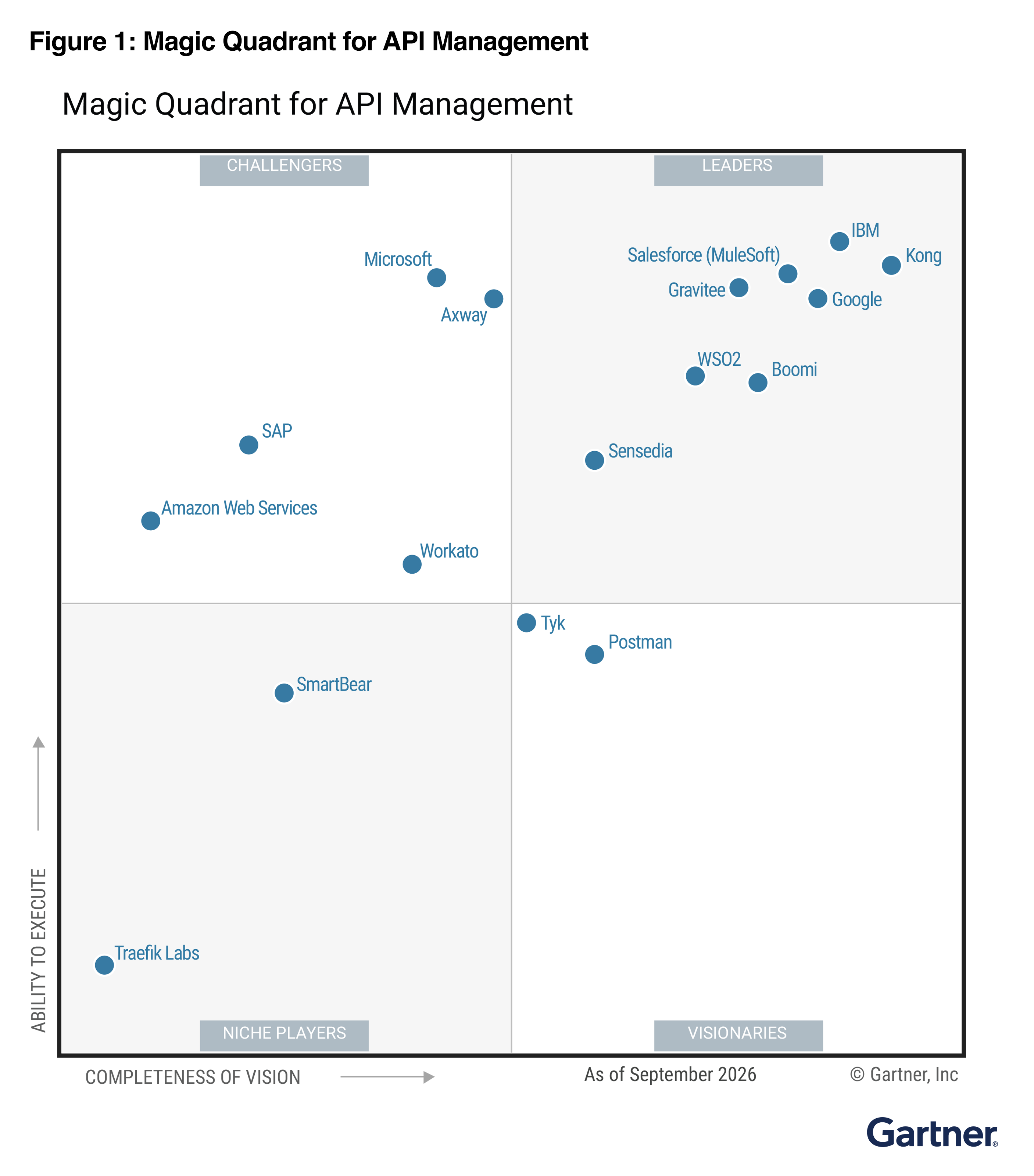
I’m thrilled to report that, for a second year in a row, Boomi has been named a Leader in the 2026 Gartner® Magic Quadrant™ for API Management. We’re proud of this recognition and all the hard work that went into achieving it. I feel our repeated placement in the Leader Quadrant validates the strategic innovation and investment we’ve put into Boomi API Management to meet our customers’ evolving needs.
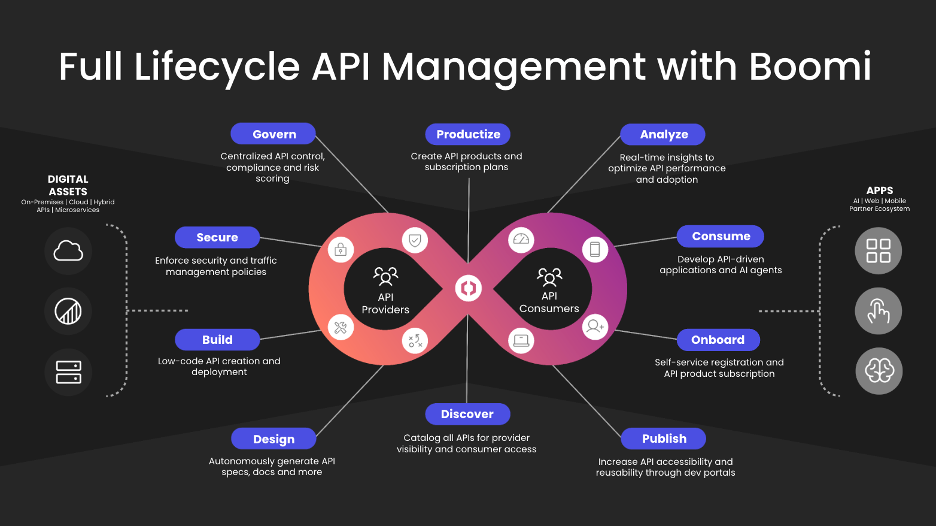
That work includes enhancing all phases of the end-to-end API lifecycle, so that customers can discover, design, build, secure, govern, productize, publish, onboard, consume, and analyze APIs through a single, comprehensive API solution. Over the past year, our continued innovation has enabled customers to accelerate their time to market with APIs and API products, more easily define and deliver critical business value from their API and AI programs, and make better investment decisions based on insights our solution delivers.
Strengthening API Governance and Security Across the Organization
We have continued adding capabilities across our API Management portfolio that ensure security and governance at every layer of your IT stack.
Most enterprises today are still wrestling with shadow APIs that aren’t tracked or managed by the IT team. These APIs pose serious security and compliance risks, and are a favorite target for hackers. Boomi API Management enables discovery of all APIs across the enterprise, automated security and quality assessments, and governance of API versions, plans, products, and policies.
Bringing together APIs from across third-party gateways — including those from Amazon Web Services (AWS), Azure, MuleSoft, Apigee, Kong, and more, plus a new discovery SDK for adding others — enables a consistent provider experience and reduces duplicated effort. Curating API products and delivering a consistent consumer experience increases API adoption. And turning those API products into MCP servers with a single click prepares them for consumption by agentic systems.
Expanding the Mission of API Management
APIs are more critical than ever before. In addition to powering ecommerce and providing the foundation for enterprise integration connecting applications and data, they are an enabler for every AI innovation. APIs connect agents and applications to LLMs and other AI models, and greatly expand the scope of what can be automated in any organization. More complex, probabilistic processes can be automated, enabling workflows to handle tasks that might include exceptions or complex situations involving multiple stakeholders and applications. APIs make all that automation possible.
Expanding the charter of APIs also expands the requirements for API management. There are new personas to account for in agentic systems, such as knowledge workers and non-human identities; new protocols and supporting technologies such as Model Context Protocol (MCP) and MCP registries; and newly popular interaction patterns such as headless SaaS and skills-based API usage.
We’ve expanded Boomi API Management to address all these challenges. We want to ensure customers can make the most of APIs, whether they’re developing traditional application services or rolling out AI assistants such as Claude Cowork, Microsoft Copilot, and Gemini for all their employees and trying to connect those tools to the business data and applications employees need.
Boomi’s Unified Vision for Connectivity
Boomi API Management delivers all this as part of the Boomi Enterprise Platform, spanning API management, integration and automation, AI agent management, data integration, workflow automation, data catalogs, event streams, and managed file transfer.
In the age of AI, enterprises need more foundational capabilities than ever before. But it’s a challenge to achieve their business goals without onboarding more vendors and managing countless point solutions, each of which delivers some individual piece of their AI and operational technology stack. With a single comprehensive platform for everything from application integration to API management to agentic workflow governance, we simplify life (and vendor management) for our customers. At the same time, we’re helping customers innovate faster and more effectively than ever before.
We have continued to deliver on the unified product strategy we announced last year, to provide federated API management, enterprise-grade scalability for mission-critical APIs in industries such as finance, healthcare, and travel, and end-to-end user experiences across the entire Boomi Enterprise Platform.
We also recently acquired an innovative leader in LLM and MCP gateway technologies, Lunar.dev, bringing AI gateway capabilities into the Boomi Enterprise Platform. Here’s why this recent acquisition matters so much.
Lunar.dev and the Importance of AI Gateways
While API Gateways traditionally focus on securing and managing the inbound consumption of application and data assets by external consumers, agentic systems depend on the outbound consumption of AI models and MCP-enabled tools. This introduces new challenges around security, cost, and observability, as new models are introduced daily and MCP tools are selected dynamically by agents based on intent.
With agents taking automated actions on our behalf using models we don’t own, managing identity and access, protecting against data loss, and introducing guardrails are key to maintaining a secure perimeter. Governing access to workload- and role-appropriate models, managing connectivity to enterprise tools, and preventing runaway costs through budget controls are just as critical for enabling enterprise-wide AI initiatives.
Lunar.dev was founded to address the unique challenge of managing these specific interaction patterns with a specialized offering, and their AI gateway delivers on this promise. Unlike traditional API gateways extended by bolting on new AI policies, purpose-built AI gateways are tailored to these scenarios: managing model lifecycles, validating MCP server capabilities and approving tools based on risk scores and token usage; provisioning model and tool access to team, user, and agent profiles; defining budgets at every level of the organization and dictating model failover when budgets are exceeded; enforcing runtime policies on all AI interactions; and collecting detailed usage data for governance and reporting.
Earlier this year, a lot of companies learned the hard way that encouraging employees to use frontier AI models as much as possible for every possible task — a practice known as tokenmaxxing — can be costly. Uber famously ran through its entire annual AI budget in just four months, and other companies experienced sticker shock from their LLM bills as well.
Though this trend also deserves a conversation about when to use probabilistic vs. deterministic workflows, one way to manage this scenario is by leveraging model routing to select the most cost-effective model. That may be a lower-cost frontier model such as those from OpenAI and Anthropic. Increasingly, though, it will be an open weight model, or a small language model trained on data for a specific domain, such as accounting or logistics, and deployed on-premises or in an organization’s private cloud. SLMs consume fewer tokens. They’re also less susceptible to hallucinations. We’re excited about how our newly-acquired AI gateway capabilities deliver the observability, control, and flexibility to enable these new approaches at scale.
Boomi Connect for Instant Connectivity to Business Data
Increasingly, AI interactions take advantage of MCP, which has become an industry standard protocol that applications and agents can use to discover and access tools, including APIs, data sources, command-line interfaces, and enterprise applications. Earlier this year, we launched our MCP Registry, making it easy for Boomi customers to catalog, curate, provision, publish, and govern every MCP server they need across the organization, including MCP servers within their enterprise as well as trusted third-party servers.
We also launched Boomi Connect, a managed MCP connector service with 1000+ connectors providing any MCP client, including AI agents and assistants, with instant, governed connectivity to applications, data stores, and more.
Many organizations have been rolling out AI productivity tools like Claude Cowork for their employees, hoping to increase productivity by putting AI at their fingertips. The problem is that these AI assistants have limited connectivity to the business applications employees depend on for their work. When they do offer some connectors for popular business applications, traffic across those connectors can’t be monitored. There’s no easy way to manage identity and enforce policies on those connections. Are employees accessing the data they should? Are they staying within their budgets for token usage? There’s often no way to tell at scale.
IT leaders find themselves choosing between rolling out ineffective tooling limited by reduced connectivity, leveraging the rudimentary, opaque connectors AI assistant vendors provide and forgoing governance, or building out manual connectors from APIs and integrations to regain some level of control.
Boomi Connect eliminates the need for all that work. It provides instant connectivity to over a thousand enterprise systems, while providing identity mapping, monitoring, and governance for every MCP connection.
Boomi Connect immediately delivers more value to knowledge worker enablement initiatives. It also improves security and governance across the enterprise. Even organizations that aren’t already Boomi customers can sign up for this service and instantly improve the digital experience and productivity of their employees. It’s a solution that builds on Boomi’s legacy of connectivity, governance, and visibility to deliver AI capabilities that were unimaginable a few years ago.
Putting Customers in Control
Boomi Connect, our MCP Registry, and our AI gateway from Lunar.dev give us the ability to federate and manage the lifecycle of AI assets in the same way that we federate and manage the API lifecycle, bringing Boomi’s longstanding expertise in API management and governance to bear on this critical technology for business transformation and agentic AI. By delivering all these capabilities in the Boomi platform, we’re giving our customers exciting new API capabilities while ensuring that they never lose out on visibility, governance, and control.
Read the full 2026 Gartner® Magic Quadrant™ for API Management.
Gartner, Magic Quadrant for API Management, Shameen Pillai, Nicholas Carter, John Santoro, 28 September 2026.
Gartner and Magic Quadrant are trademarks of Gartner, Inc. and/or its affiliates.
Gartner does not endorse any company, vendor, product or service depicted in its publications, and does not advise technology users to select only those vendors with the highest ratings or other designation. Gartner publications consist of the opinions of Gartner’s business and technology insights organization and should not be construed as statements of fact. Gartner disclaims all warranties, expressed or implied, with respect to this publication, including any warranties of merchantability or fitness for a particular purpose.
This graphic was published by Gartner, Inc. as part of a larger research document and should be evaluated in the context of the entire document. The Gartner document is available upon request from Boomi.