



































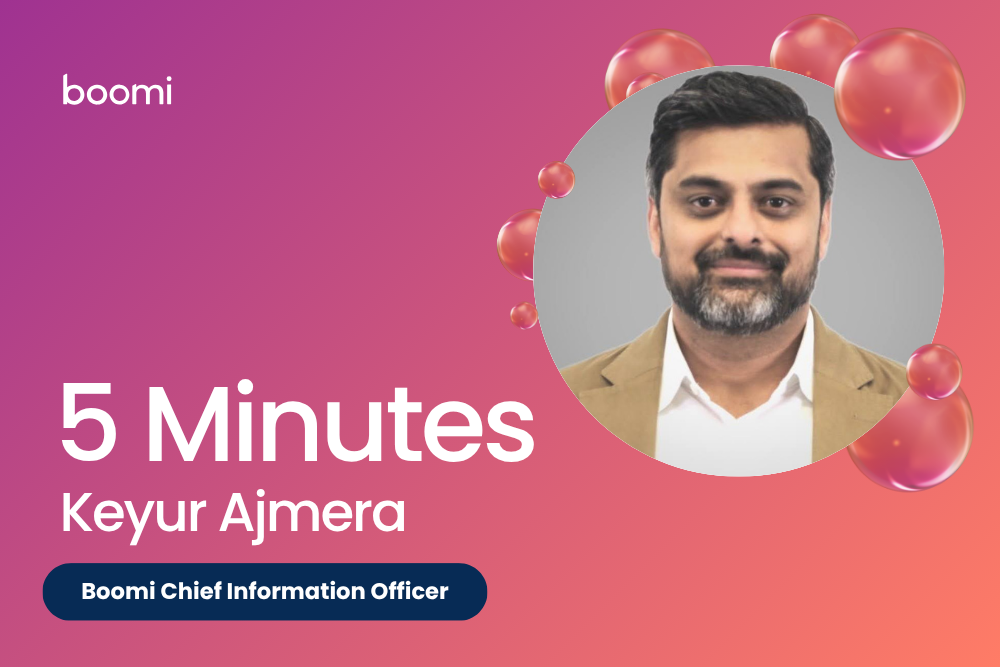
Boomi highlights business thought leaders, the trends they see, and the cool things their organizations are doing. We also find out how data and automation improve their everyday lives.
For Keyur Ajmera, the role of the modern chief information officer is evolving at the same breathtaking pace of technology innovation.
It wasn’t all that long ago that the CIO role was largely defined by managing data centers, cloud infrastructure, IT costs, and so on. While all of that remains part of the job description, the arrival of AI has transformed the job — almost overnight — by adding new dimensions.
“It’s now about being a partner to the executive team and the business so that we can embrace and leverage AI at incredible speed and unprecedented scale,” he says. “It’s not about putting in systems anymore. CIOs today must be true enablers of business momentum, executing technology rollouts on compressed timelines that we’ve never before seen.”
As the Boomi CIO, Ajmera rolls up his sleeves to lead the charge to adopt cutting-edge AI systems and agents across every aspect of the business where they make sense.
“A CIO today has to be more hands-on,” Ajmera adds. “How can I enable my business if I don’t know how to use or build something myself? If you’re running an IT organization, you need to be a deep technologist. You must be that ‘customer zero’ for any technology before it’s rolled out to your colleagues.”
Ajmera took time to discuss how AI is impacting CIOs, how long it will take before people trust it in their daily lives, and his work mentoring young people interested in technology careers. Our conversation was lightly edited for length and clarity.
What are the biggest challenges facing CIOs today?
Keyur Ajmera: At the highest level, the two things that almost every single CIO is worried about primarily are the costs associated with their systems and everything associated with AI. Because of the rate at which AI is evolving and how much change it’s bringing, every CIO is under a considerable amount of pressure from their executives, their peers, as well as the board to constantly deliver innovation using AI while keeping a close eye on cost and making sure they do a whole lot more with a whole lot less. At the same time, we often don’t fully appreciate how important security is to CIOs. If you’re a CIO of a large company, data security and privacy are top of mind. You might have a locked-down security posture that blocks many AI tools rather than enabling progress. But then leadership also wants you to do AI. So, it’s a balance as CIOs are constantly under pressure to drive greater AI adoption across the business and safely deliver value through revenue generation or cost elimination.
How do you think AI is different from other “moments” in technology innovation?
Keyur Ajmera: A big change is that we’re used to technology always working as expected. Yes, there would be bugs and some errors. But we would correct them. We’ve reached a point where we’re very trusting of technology. Now, with autonomous processes, we have a new technology where we might have trust, but we still want to verify.
How long do you think before we reach the point where there’s widespread confidence in AI?
Keyur Ajmera: We might not be there yet, but we will be pretty soon. I have zero doubt about that, given the pace of AI’s evolution. You probably trust AI today. If your car has any degree of autonomous driving, you might be pretty comfortable taking your hands off the steering wheel or your eyes off the road. For me, the degree to which more people learn to trust autonomous technology will grow very quickly. There are other cases where we already do, but we don’t even think about them. Another piece of technology that you’ve trusted your life with is autopilot on a commercial jet. The only time a pilot is fully involved is during takeoff and landing. For the rest of the time, every single commercial jet more or less flies itself. And that’s not even AI.
What is a common misunderstanding about AI?
Keyur Ajmera: I don’t know if it’s a misunderstanding, but the general notion right now is that AI will replace humans at work. I believe that what people generally overlook is how AI can make humans “superhumans.” We fear that which we don’t understand. It’s human nature. But once you learn how to use it and harness it, you see that it does not replace you. Instead, it can be a huge amplifier to what you do. I’m an optimist. I believe in AI for good and that it can be tremendously value-additive to every individual’s life. Anybody trying to reach a customer success rep two years ago might have waited 10 or 15 minutes before speaking with someone. Now, you can have an entire interaction with an agent to resolve issues, day or night, 24/7. We don’t even think about that twice today. That’s evolution to me. It goes back to that trust question. The more responsible AI controls we have, the greater trust it will gain. I genuinely believe it can effectively make us superhumans, allowing us to be so much more productive and get a lot more of our lives and time back.
You like to ask the question “So what?” when tackling a problem. Can you explain what that means?
Keyur Ajmera: I always break down everything into its simplest elements. We all know about Simon Sinek and the idea of starting with the “why.” That’s always resonated with me. But I’ve taken that to the next level. For technologists in general, it’s our nature to pivot toward the “how” to find a solution. But the thing that gets missed is, “OK, we solved it, but what’s the ROI?” The most important role of the CIO now is in driving ROI. The way you do that is simply by asking the “So what?” question. OK, I brought this whole beautiful thing to production. But if it’s not adopted, if it’s not yielding savings or driving revenue, then what’s the value? What good is it? Maybe I solved a problem, but how is it moving the needle? It makes you really think about the value of doing something.
What’s something about you that we wouldn’t know from your LinkedIn profile?
Keyur Ajmera: One of my greatest passions originated from a phase of my life when I could have used some help, between 16 and 22. No matter where you grow up, young people are grappling with choices like education and career paths. Everyone goes through that journey. That’s a very confusing time. What I do now is I coach and mentor a lot of young people, from high school to college to early career, and help them be better informed about the career choices they have available to them. I will never say no to anybody who asks for help. I always start with simple questions. What is it that you like to do, and what is it that you’re really good at? It’s about seeing the art of the possible. It’s just as transformative for me as it is for them. It gives me energy. Helping young people find their path is deeply rewarding and fulfilling for me.
Give us an example of how you use AI in your day-to-day.
Keyur Ajmera: I have Claude Cowork schedule a task at 7:30 every morning. That task looks through all my Slack messages, calendar invites, and emails, and gives me a daily digest of everything I need to do. Here are the top-priority items that need my attention. It’s a quick five-minute daily digest that helps me organize my day better. That morning briefing is absolutely a game-changer for me. I don’t know how I lived without this.
Up Close With Keyur Ajmera
 Role: Boomi Chief Information Officer
Home: Bridgewater, N.J.
Family: Wife Anastasia, who is a speech-language pathologist. “She works with special-needs kids, and it’s so noble how she helps shape young lives and helps parents who might be struggling.”
Education: Bachelor’s degree, Computer Engineering, University of Mumbai; Master of Science degree, MS, Computer Science, San Francisco State University
Career: Joined Boomi in September, 2025. His more than two decades of experience include senior technology leadership roles at AppDynamics (a Cisco company), PwC, INTTRA, and Deutsche Bank, as well as serving as the first CIO of iCIMS. Most recently, he was the Senior Vice President of Technology Operations and Innovation at Towne Park.
Interests outside of technology: He has an affinity for cars and watches, particularly those associated with Omega’s James Bond collection. “For me, a watch is technological perfection because it runs entirely on kinetic energy. It’s self-sustaining technology at its finest.”