



































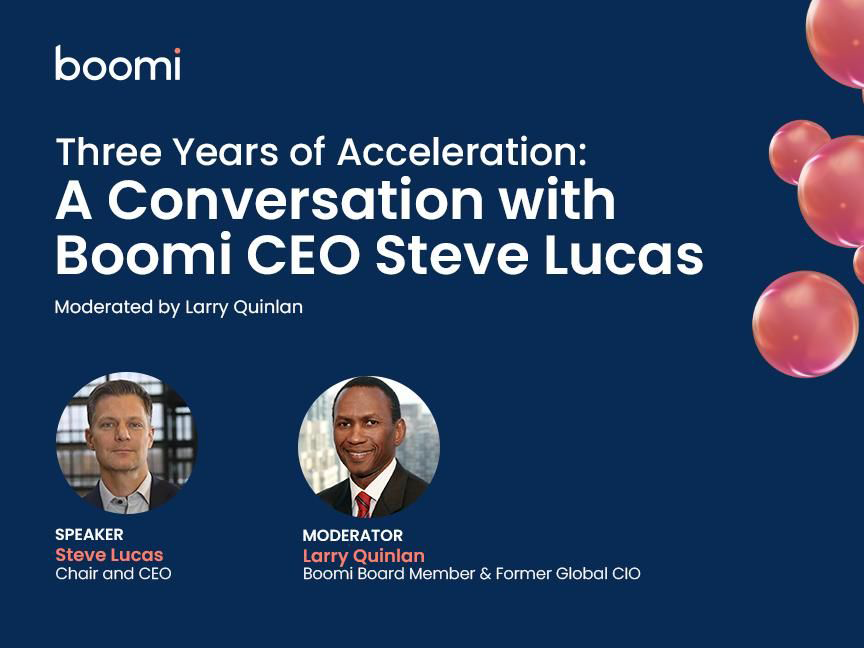
Steve Lucas took the helm at Boomi three years ago, just as the shoreline retreated before the ChatGPT tsunami struck. “It felt like standing on a beach and watching the water suddenly pull back,” he recalled. “You knew there was something big coming, but you couldn’t see it yet.”
That moment of awe didn’t lead to hesitation. It triggered a breathtaking expansion of the Boomi integration mission: embracing data activation capabilities to build a trusted foundation for AI-enabled automation. In a wide-ranging LinkedIn Live discussion with Larry Quinlan, former Global CIO of Deloitte, Lucas explored Boomi’s evolution, the growing importance of the CIO role, and why 2026 is the pivot point when AI shifts from pilot mode to business driver.
“I truly believe we’re entering a value realization era where we’re going to see AI move from evaluation into production, particularly with agents,” Lucas says. “This is the year of ROI.”
Here are highlights from their discussion.
What stands out the most to you when you reflect on the last three years?
“First of all, leading through constant change. When you’re running a software company, you’re running the company that got you here, and you’re re-imagining the business with AI. It’s balancing urgency with long-term thinking. You really have to challenge yourself daily. I’ve learned more in the past three years than in the previous 10 because of that sense of urgency. You wake up one morning, and there’s a new white paper that AI could change this, or humanoid robots might do that. It’s not just balancing short-term and long-term thinking. It’s about being resilient. I like to work on cars, and I have this firm belief that the windshield is large and the rear-view mirror is small for a reason. You need to spend your time looking forward. It’s about going fast, understanding what your customers need, and driving toward that vision.”
Why do many organizations struggle to get from experimentation to production?
“Let’s take a step back and think about what AI and agents really are. You have this large language model that’s been trained and grounded for specific outcomes. These large language models will produce output that is 100% dependent on the data that you fed them. Data quality is the No. 1 challenge when it comes to AI ROI. Period. Full stop. If you’re gonna feed this engine anything less than hyper-accurate, hyper-precise data, it’s just going to give you an inaccurate response. Then you have to think about access control. Who is this AI acting on behalf of? Is it on itself? Is it another human being like the CFO? These are only two of dozens of challenges that we need to overcome with AI. Another important one is knowing when you don’t need AI. A probability engine won’t help me decide whether to run payroll on Friday. That’s one line of deterministic code. But would an AI agent be better to rationalize expenses in one system with financial entries in another? We have to balance the point between where AI can be extraordinarily effective versus when it’s not. Companies that get good at understanding the advantages will create disproportionate advantage from AI.”
You recently declared 2026 will be the year of AI activation. What should CEOs focus on to make that come true?
“CEOs should be focused on ensuring they have the right technology stack. It’s not just, ‘Oh, well, let me select Claude from Anthropic, Gemini from Google, or ChatGPT from OpenAI. CEOs understand the landscape of models, but not when it comes to what those models are and are not capable of doing. There’s too much hype right now. I haven’t been able to pick up my phone yet and say, ‘Sell more software,” and then it just happens. We’re not there yet. But it’s incredibly important for CEOs to understand that the rules and the technology stack are being rewritten. It’s not just the model. It’s about picking your data activation layer and tying it into the existing business processes. No one will tear out their ERP system because 15 years from now, AI might be good. So, how do you integrate AI insight agents into your existing workflow? There’s the foundational model layer, the data activation layer, and then the integration layer. That may sound like a CIO’s job. But that’s the job of the CIO and the CEO. And if you’re a CEO who defers all that to your CIO, you’re doing it wrong.”
How has this AI moment shaped Boomi’s strategy over the last three years, and where do you see it going?
“When you’re in a new job, you step back and soak in things. I flew around the world and talked to customers. Now we’re the leading integration platform, but when I asked what Boomi does for them, not once did I hear the word integrate, which I found odd. They said Boomi automates our data processes and activates our data for applications. Then, when I talked to analysts, they said, ‘Well, you’re an integration platform as a service.’ But taking it back to that ChatGPT AI moment, we realized the need to be a data activation platform. That meant adding a very deep data management stack with more ETL, ELT, data quality, and master data metadata capabilities, to complement what we already offered in iPaaS. We did the same for API management, and then for AI management. You have to activate the data to make AI effective. I can tell you unequivocally that today, through organic innovation and acquisitions, we are firmly ready to be the singular data activation layer for your business.”
When you think about the future, are you excited or terrified?
“I do think about what this costs us if we defer more to the machine. I wrote a book called ‘Digital Impact.’ The subtitle is The Human Element of AI-Driven Transformation. Isn’t AI supposed to be for us, for humans? Isn’t it supposed to make our lives better? AI will definitely impact current jobs, but I think it will create new ones as well. If AI is supposed to be for us, we have the right to define it. Let’s define it together. Let’s not just accept one or two people’s views on how the world should work with AI. We’re going to benefit profoundly as a human race from this. It will not just create new jobs or help us live longer, healthier lives, but I think we will find ways to see more truth in the world, not more false. I’m excited about those things. So, I’m optimistic.”
What do you think AI will do to the CIO role?
“The CIO should be the Chief AI Officer. The CIO knows that this heavy mantle rests on their shoulders. The CIO becomes the person who understands the intersection of deterministic and probabilistic, and the transformation that must take place inside an organization. A CIO appreciates the careful balance. It’s why the CIO’s role becomes more strategic and more important than ever.”
What have you learned from the people at Boomi?
“First and foremost, our people do genuinely care how AI plays out. I have heard thousands of times from Boomi team members about their sense of responsibility for governing AI. One of the reasons we built Agent Control Tower is that we believe every organization needs an independent, neutral platform that gives you insight into what the heck AI is doing everywhere. Every API call and every action that it takes must be observable, manageable, and controllable by humans. I feel so passionately about that. But our team members care 10 times more than I do. And they show up every day thinking, ‘Well, if not us, then who?’ And I love that attitude.”
Five Takeaways from the Steve Lucas LinkedIn Live Conversation
- The Year of ROI: 2026 marks the end of AI experimentation as businesses focus on agentic AI that delivers measurable value.
- The Data Quality Imperative: Inaccurate or low-quality data is the single most significant barrier to AI success.
- The New Enterprise Stack: Success requires a three-layer approach: foundational model, data activation, and integration.
- The CIO/CEO Alliance: AI strategy requires a unified partnership between the CEO and the CIO.
- Human-in-the-Loop Governance: Independent, neutral governance is non-negotiable to ensure that every AI agent’s action is observable and controllable.
An on-demand recording of the discussion is available here.