





























Gartner® estimates that, “Agentic AI is set to disrupt enterprise software revenue models.¹” This explains why every platform vendor has spent the last eighteen months building toward the same layer. If value moves out of applications and into autonomous execution, then wherever agents get built, grounded, governed, and run becomes worth owning.
This explains why every platform vendor has spent the last eighteen months building toward the same layer. If value moves out of applications and into autonomous execution, then wherever agents get built, grounded, governed, and run becomes worth owning.
So the question we keep hearing from enterprise architects, “Which agent builder should we standardize on?”, is a smaller question than it sounds. Agent builders may come and go, but the foundation underneath them is much harder to replace. And your agents are only as good as that foundation.
So the bigger question becomes which vendor should you partner with to create the backbone for your agents’ success? Every vendor will tell a different story about why their layer should be the one. Your job is to cut through the noise and make the right call for your business before it gets expensive to change.
What you’ll learn in this blog:
- Why the major players’ context layers are built around their own ecosystems
- What that optimization does to agent behavior in production
- How consolidating on one vendor can leave you with more fragmentation, not less
- What an agent control plane has to do to earn the name
- How to pressure-test an ecosystem default before you commit
Every Cloud Giant’s Context Layer Has a Home Ecosystem
Agents run on context: the customer records, product data, policies, documents, and business rules they reason over. That context lives in data stores, so the fastest way to read any vendor’s agent strategy is to look at where its data stores sit and what they were built to serve. For the major players, the answer is clear: their own stacks.
- Salesforce grounds Agentforce through Data 360, unifying enterprise data around a customer-centric view.
- SAP‘s Business Data Cloud and Knowledge Graph give agents semantic depth, and an SAP-shaped world view along with it.
- Microsoft IQ centers on Microsoft’s own ecosystem, bringing together Microsoft 365 content, data in Fabric, and enterprise knowledge through Foundry.
Each performs well inside the boundary it was designed for. The harder question for an architect is what happens when those boundaries are crossed. Agents will spread across the enterprise, not stay inside one vendor. How does a context layer tuned for one ecosystem handle that?
When Optimization Becomes a Constraint
An agent is a reasoning layer running on whatever context you hand it, so the shape of the grounding layer ends up being the shape of the agent’s judgment. Think of that layer as a box built to a specific size. Context from the home ecosystem fits perfectly. Now try to fit a soccer ball, then a couch, then a car, then a lake. The box wasn’t built for them. You can force some of it in by replicating, mapping, and maintaining it, but it never fits the way native content does.

In practice, this causes three problems for enterprises:
- Context shaped by one ecosystem. Optimizing for one vendor, rather than the full enterprise.
- Vendor and architectural lock-in. Limits long-term strategic flexibility as AI proliferates.
- Conflicting and duplicate records. Without master data management (MDM), inconsistent data degrades agent accuracy.
One Ecosystem Does Not Mean One Platform
Here is the part that catches people out. Consolidating on a single vendor is supposed to cut down fragmentation, and in the agent layer it often does the reverse. Look at how the major stacks are assembled. There’s a product for design and build, a different one for workflow orchestration, another for governance, another for connectivity and tooling, another for context and data. Each has its own console, its own stock keeping unit (SKU), its own admin model, its own release schedule.

Instead of simplifying the stack, customers can end up with more tools, separate governance and context layers, and added integration work. The cost shows up over time through specialist skills, administration, and the effort required to manage change across multiple products.
The bigger risk is lock-in. When one vendor becomes the home for business definitions, entity resolution, and the context agents rely on, switching becomes more than a technology migration. A vendor-neutral control plane keeps those choices open across applications, models, and clouds.
What an Agent Control Plane Has To Do
Before comparing vendors, it helps to define the job. A control plane worth the name does three things.
Grounds agents in rich, enterprise-wide context
Agent accuracy is a data problem before it’s a model problem. You need trusted master data, business definitions people agree on, and retrieval across structured and unstructured sources, and it has to survive changes to your application strategy and your AI strategy. Both will change.
Governs the entire AI estate, not just the agent
An agent in a demo is a builder. An agent in production is a builder plus integrations, APIs, MCPs, LLMs, events, tools, trusted data, governance, and somewhere to run. When those sit in different products, every change turns into a scheduling exercise across teams that don’t share a release calendar.
Delivers a consistent, centralized experience everywhere
Some workloads have to run near the data, behind the firewall, or inside a specific region. If your control plane assumes cloud-hosted execution, those workloads move onto a second stack with a second operating model, which is an ongoing operational commitment rather than a deployment detail.
How Boomi Approaches It
#1 A vendor-agnostic foundation for data and context
Vendor neutrality matters more than ever in the agent era. The platform grounding your agents becomes a foundation for business data and context. Tying that foundation to one vendor ecosystem increases long-term dependency.
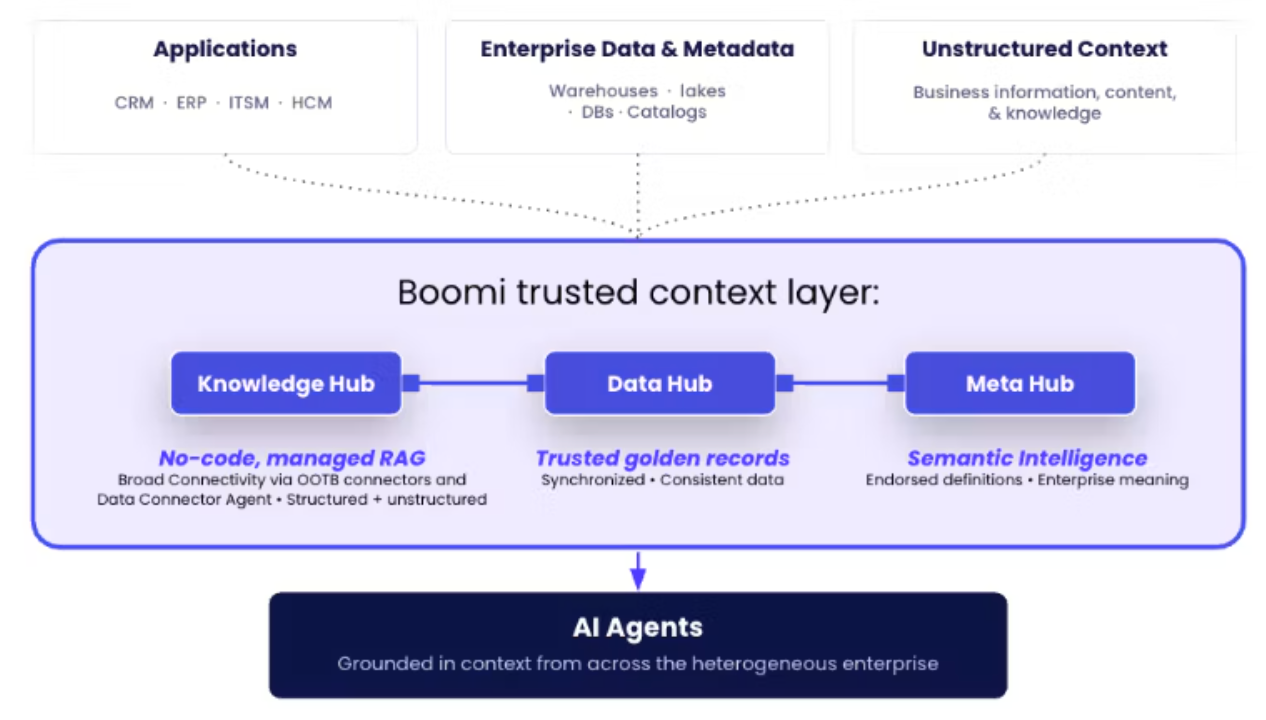
The Boomi Enterprise Platform grounds agents through three capabilities that sit right underneath the agent layer, none of which assume your business runs on one vendor. Boomi Data Hub provides trusted master data, so agents act on the right records. Boomi Meta Hub provides governed business definitions, so agents share the same meaning of terms like “customer” or “revenue.” Boomi Knowledge Hub provides managed, no-code RAG across enterprise data and documents, grounding agents in trusted context.
#2 One platform, from agentic design to governed execution
With Boomi, the capabilities needed to run agents in production are part of the same platform: design and orchestration, agent and tool governance, integration, APIs, events, and trusted data. They share a common operating model and controls, giving business and IT a consistent way to work together.
Other approaches can require separate products for orchestration, governance, connectivity, and context, each with its own owners and release cycles. That complexity becomes more significant as you move from a few agents to managing them at scale.

#3 Hybrid deployment on one runtime model
Boomi decouples runtime from design time, allowing agentic workloads to run in cloud, hybrid, or self-hosted environments using the same runtime model. In contrast, other vendors may offer more restrictive deployment options or require more complex infrastructure for local agent execution, potentially increasing operational overhead.
Better-Together: Use Their Agents Where They Fit
Most enterprises are still defining their agent strategies and deciding which platforms to invest in as Microsoft, Salesforce, SAP, and others push their own ecosystems. But adopting one vendor’s agents doesn’t mean committing to that vendor for everything.
Keep agent development flexible. If your Salesforce team wants Agentforce and your Microsoft users want Copilot agents, use them where they fit. Then use Boomi across those environments to provide shared context, cross-platform orchestration, and centralized governance.
- For agents that stay within one ecosystem, use the native tooling.
- For agents that need to work across ecosystems, use Boomi for context, tools, and orchestration.
- For governance across all agents, use Boomi as the neutral control plane.
Three Questions to Ask Before You Accept the Default
If you are evaluating an ecosystem agent platform right now, these three will tell you more than a feature comparison:
- Will the data, context, and systems your agents need live in one ecosystem? Map where the context has to come from before you decide where agents get built.
- What else needs to come together before that agent can actually go into production? Look at the products, platforms, and teams involved.
- What happens to workloads that have to run outside the vendor’s cloud? Consider what you need to deploy and manage, who owns it, and what it would take to switch directions in a few years.
Key Takeaways
The cloud giants are moving fast, but their agent platforms are strongest within their own ecosystems. As you scale, that can mean more products, infrastructure, and dependency on one stack.
Boomi is built for multi-vendor environments, bringing trusted context, governance, and flexible execution together without locking you into one ecosystem.
¹ Gartner Press Release, Gartner Says $234 Billion in Enterprise Application Software Spend Is at Risk from Agentic AI, July 2026. Gartner is a trademark of Gartner, Inc. and/or its affiliates.