













Context means everything in business. That’s why we’re pleased to announce the general availability of Boomi Meta Hub. Meta Hub is Boomi’s context-aware metadata management service that natively integrates proprietary business context into agentic workflows within a single automation platform.
Business context is essential for ensuring AI agents understand what data means and how it should be acted upon. Without semantic memory to provide contextual information, AI agents are left guessing what data means and how it should be used. The result? Guesses, hallucinations, and unreliable autonomous actions that pose significant operational and regulatory risks.
Meta Hub solves the problem of missing business context by providing native, in-workflow metadata directly in the Boomi Integration workspace. This eliminates the manual step where IT teams must fetch information from data catalogs, introducing delays that jeopardize the efficiency of agentic AI. Meta Hub delivers context quickly and efficiently, while ensuring it follows data throughout workflows.
“The magic of Meta Hub is that it provides universal lineage for every organization’s most valuable asset: data,” says Ed Macosky, Boomi’s Chief Technology and Product Officer. “It grounds AI agents with the full context of the enterprise that’s connected by the Boomi platform. Businesses always know where their data comes from and what it depends on. That way, they can always trust it.”
Here’s a more detailed look at Meta Hub.
A System of Record for Business Context
Meta Hub serves as an organization’s system of record for business context. It provides a central glossary of endorsed business terms that eliminates ambiguity and confusion across data sources. Meta Hub gives AI agents the context and business rules needed to act safely and accurately. Meta Hub digitizes tribal knowledge, standardizing terminology so everyone — both humans and AI — can operate from the same source of truth.
主なポイント
Using Meta Hub, organizations can:
- Ground agentic AI in trusted data. Teams can eliminate context-free guessing by feeding agents expert-endorsed definitions as semantic memory.
- Establish a single, consistent business language for people and agents. Meta Hub enables teams to work with trusted, standardized definitions for key metrics and fields such as “customer” and “revenue.” Data teams no longer have to rely on word-of-mouth or shadow spreadsheets for formally curated and expert-endorsed definitions. Teams can also accelerate development by giving developers endorsed business meaning without leaving the Boomi workspace.
- Eliminate technical blind spots. With Meta Hub, developers reduce operational risk by understanding downstream consequences before modifying fields or integrations. Meta Hub also lets them trace any data value back to its contributing source rather than relying on stale assumptions to determine how that value came about. IT teams can audit agent activity by following an agent’s reasoning back to endorsed definitions within Meta Hub, transforming opaque AI behavior into verifiable accountability.
Building Business Glossaries Made Easy
Meta Hub’s AI Suggest feature uses existing metadata to automatically build rich, accurate business glossaries, helping organizations establish a semantic layer across departments and domains. Once that layer is established, teams no longer have to rely on complex, individual prompts to agents to provide the context agents need. Instead, agents can rely on glossaries in Meta Hub.
With AI Suggest, building glossaries becomes easier than ever.
- Build rich, document-like glossaries. Developers or business analysts can begin drafting a glossary with AI Suggest, then shape it into the definitions and rules the organization actually uses. For example, if EMEA customers should automatically get a 10% discount on renewals, that rule can be described in a glossary, so it’s applied every time an agent works with data records for EMEA customers.
- Get glossaries endorsed by experts. Organizations can assign one or more experts for each glossary. Once an expert endorses a definition, Meta Hub marks it as “endorsed” and records who performed the action and when. Creating records like this makes it easy to determine which definition is current.
- Link glossaries to the data models they describe. Connect a glossary to the Data Hub models it governs and the agents that use it.
- Update business rules in one place. When a rule changes, update it once. Meta Hub automatically ensures every linked agent uses the new version of the rule, so data is acted on consistently across the organization.
Building and managing glossaries with Meta Hub creates a unified context layer. The business rules that agents need to act safely and reason accurately are kept up to date by the organization’s own experts.
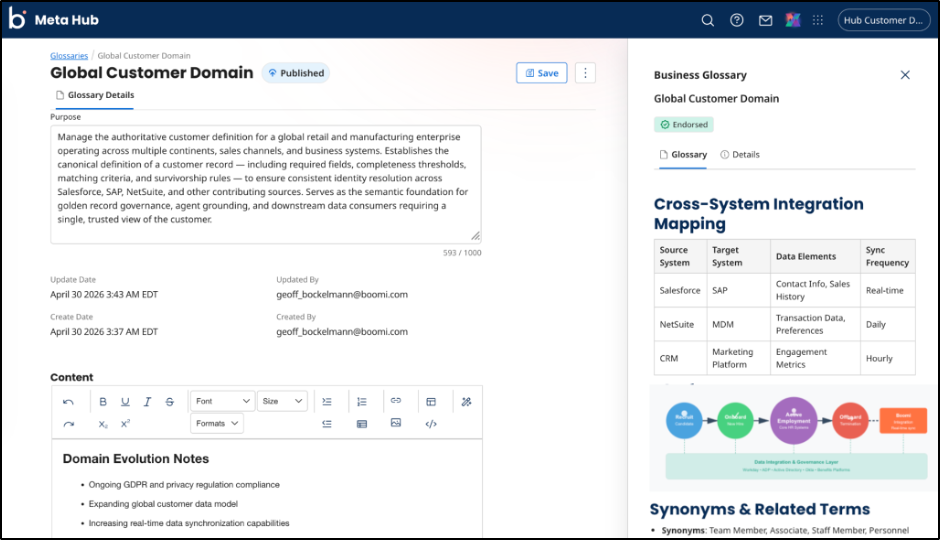
Define your business rules once, in one place. Meta Hub glossaries capture what a term like “customer” means, with tables, diagrams, and synonyms, and your experts endorse them so people and agents work from the same trusted definition.
Data Lineage Provides Visibility Into Data Dependencies
It helps to see what a definition is connected to before changing it.
Data lineage (currently in Early Access) in Meta Hub maps data connections across your Boomi landscape, showing which sources feed which Data Hub models and which tables are connected to Boomi Data Integration pipelines. Data lineage analysis comes straight from an organization’s Boomi setup. So it reflects what has actually been built. In future, the analysis will prompt subject-matter experts to review and formally endorse data dependencies in their domain of expertise. Once endorsed, Meta Hub will mark the linkages as confirmed and trusted, giving developers and business analysts a true understanding of data linkages and their status.
Data lineage delivers these benefits:
- Faster root cause analysis. When anomalies occur in agentic AI or business intelligence (BI), it’s easier to discover the cause by tracing data lineage.
- Faster downstream impact analysis. Developers, data scientists, and others can more quickly discover the impact of changing data when they can see how it’s used across pipelines, data sources, and agents.
- Improved data trust and reliability. Data becomes more trustworthy when teams can easily discover its origins and how it was transformed.
- Data explainability. Teams can more easily understand data and the results it produces when they can easily discover its source and the history of its transformation.
- Regulatory compliance and auditing. Data lineage helps engineering and compliance teams see how sensitive data such as Personally Identifiable Information (PII) is handled across data pipelines, agents, and applications, helping teams ensure compliance with regulations such as GDPR, HIPAA, and PCI DSS.
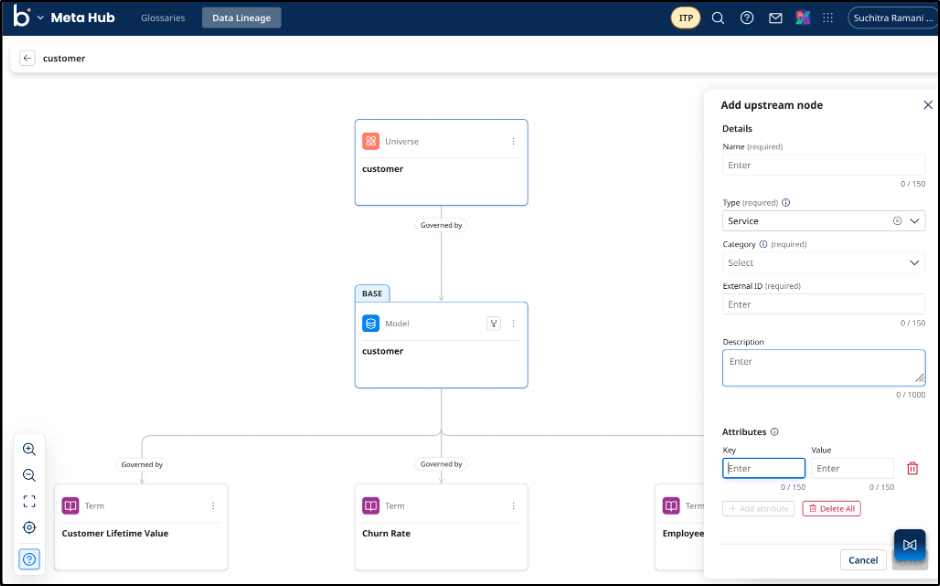
See what a definition is connected to before you change it. Meta Hub lineage maps how data connects across your Boomi landscape, from the sources feeding Data Hub models to the tables in Boomi Data Integration pipelines, and links each model to the glossary terms that govern it.
“Enterprises are getting serious about accuracy as they move into production with agentic AI,” says Kevin Petrie, Vice President and Head of Data Management Practice at BARC. “Boomi Meta Hub helps achieve this. It minimizes hallucination risk by integrating diverse metadata into governed context for agent decisions and actions. This ensures that AI-driven workflows are grounded in the nuanced business reality of the enterprise.”
Data is the fuel AI needs to drive results and value. Meta Hub gives businesses confidence that AI agents are taking action and making decisions based on accurate data.