






























主なポイント
- Statistics shared by industry leaders in Factor Research’s The Common Factor series talk show episode “Activating the AI-Ready Enterprise: Why Integration, Automation and Governance Must Come First” highlight the execution gap between AI ambition and execution.
- AI agents require end-to-end connectivity and a resilient nervous system of APIs, integrations, and workflows to make contextual decisions at enterprise scale.
- Agentic governance shifts from binary access control to governing what autonomous agents can process and present.
Many enterprises start with grand ambitions for AI, but quickly run into roadblocks. As enterprise AI adoption continues to grow, it has become clear that the underlying operational infrastructure is even more important than the AI models themselves.
To successfully close the gap between ambition and execution, executives must ensure the three foundational elements of integration, automation, and governance — the building blocks for data and AI readiness — are in place before chasing the next advanced model.
Statistics shared by industry leaders in Factor Research’s The Common Factor series talk show episode “Activating the AI-Ready Enterprise: Why Integration, Automation and Governance Must Come First” highlight this execution gap:
- 41% of tech leaders report that fragmented integrations delay execution
- Only 19% of tech leaders feel fully prepared to meet growing AI demands
This short clip featuring Boomi’s James Houston, Head of Customer Success APAC, illustrates the importance of governance and visibility for data activation:
Bridge the AI Brain Gap
Why does agentic AI need integration and API connectivity first? Senior technology leaders on Factor’s talk show, including Keiren Lawrence, CIO at Brickworks, Ankur Chakore, Senior Manager Architecture at NBN Co, and Jarryd Keir, Manager Integration Services at CEnet, illustrate the connection between AI and corporate architecture. An AI agent functions like a brain, capable of reasoning, analyzing, and synthesizing information to make decisions.
However, the AI agent requires a resilient nervous system comprising APIs, integration layers, and automated workflows to function securely across the enterprise. Without comprehensive connectivity, agents remain isolated, struggling to resolve disparate identifiers across systems, such as matching an ERP customer ID with a CRM record.
As Keiren Lawrence pointed out, missing end-to-end connectivity restricts organizations to small use cases or isolated productivity wins, “If you haven’t got the connectivity problems end-to-end solved, you’re only going to have really small use cases or individual productivity. Without that end-to-end connectivity, you limit the ability to make intelligent decisions because you’re missing a lot of the context across the data.”
If an agent lacks real-time access to semantically rich data, it cannot make contextual decisions, transforming potential automation into operational risk. James Houston recommends an 80/20 rule for agentic AI challenges: 80% of the effort goes into operational data access, back-end connectivity, and governance, while only 20% concerns the choice of the language model itself.
The absence of seamless, end-to-end connectivity across systems such as ERP and CRM databases, with an established source of truth for data, limits companies to simple dashboards or limited, local productivity gains, rather than comprehensive, enterprise-wide decision-making.
Moreover, deploying AI without these operational fundamentals exposes organizations to significant risks, including compliance failures, data privacy vulnerabilities, and financial liability.
Master The AI Multiplier Effect
Just as a healthy nervous system ensures the brain performs at its peak, these operational fundamentals are only the starting point. They pave the way for the true AI multiplier effect, where investments translate into enterprise-wide transformation across the three critical pillars of data, processes, and people.
Data Maturity
AI depends primarily on trusted, consistent data. Ankur Chakore, shared how early investments in data architecture laid the groundwork for AI readiness, “We took actions to put all our data in one place with a strong governance layer on top of it. So when the AI wave came along, we found ourselves in quite a good position to take advantage of the work we had done.” Without a unified source of truth (golden records), AI applications will merely accelerate and amplify inaccuracies at enterprise scale.
Standardized Processes
Pilot projects often succeed in small, localized environments. However, scaling AI across an enterprise without first standardizing underlying business processes leads to operational roadblocks and system inefficiencies. As Lawrence noted, “AI is a multiplier. Any weaknesses in any of the areas of data, processes, or people is going to multiply. You’re going to find it quicker, and it is going to be exposed very rapidly.”
The Human Element
Technology adoption fails when workforce culture is neglected. As operational advancement accelerates, organizations must equip employees with the training, support, and growth mindsets needed to transition from executing manual tasks to managing AI agents. Lawrence emphasized building this “muscle of organizational change” to ensure teams grow alongside technological capability.
Non-Human Identities: The New Paradigm of AI Governance
Traditionally, IT governance operated on a binary model, where access control tokens simply permitted or denied a user’s access to datasets. Agentic AI fundamentally alters this security dynamic, giving rise to a new discipline: AI agent governance.
AI governance is no longer limited to controlling direct access to data. Instead, it entails managing what an autonomous agent is permitted to process, synthesize, and deliver to end users.
Elaborating on this operational shift, Jarryd Keir says that, “In a traditional integration framework, governance is binary. You have a token that says yes or no, can you get access to that data set? But now we’re looking at how we govern AI and access to vast data sets. We’re moving from a simple access governance layer to controlling what AI can think and present to our users.”
Keir illustrated this challenge with a practical example from education: ensuring a student using the same AI chatbot platform as a teacher cannot craft a prompt to manipulate the agent into retrieving restricted administrative data. To mitigate this risk, CEnet prioritizes heavily guardrailed, sovereign LLMs within their own infrastructure over public models.
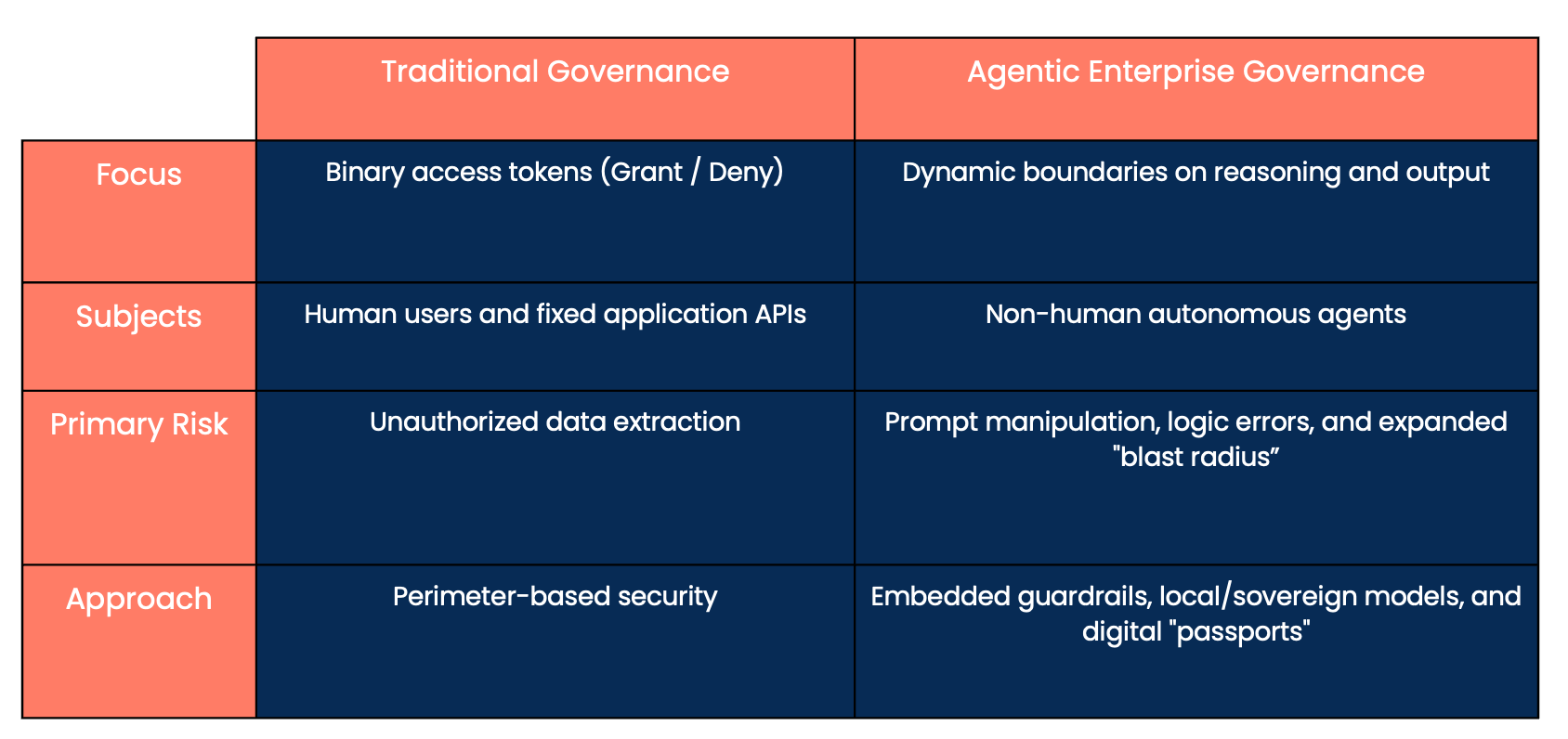
When autonomous agents are given the authority to execute actions across various workflows, the absence of human oversight means a single logic flaw can trigger a substantial blast radius. As a result, evolving risk and compliance demands are shifting organizational discussions from evaluating an AI’s capabilities to determining how effectively it can be monitored, controlled, and audited.
Keir added that because integration platforms excel at human-to-machine or machine-to-machine connections, enterprises urgently need updated frameworks to govern delegated non-human identities—providing a highly monitored “passport” for agents operating across systems.
Further, Chakore noted that as agentic sprawl expands across sub-teams and business units, establishing a centralized technology and AI governance framework becomes an operationally critical requirement to handle edge cases and exception management when an agent makes an unintended decision.
Transitioning From Experimentation To Tangible Outcomes
Preparation is the defining factor that separates enterprises successfully deploying agentic AI at scale from those trapped in continuous experimentation. The current crop of AI leaders spent the last decade establishing a solid foundation by modernizing data architecture, consolidating point solutions into unified platforms, and formalizing operational rules.
Chakore highlighted how using AI assistants in software development to analyze legacy code, automate testing, and compress development timelines reduces cognitive load and opens the door to broader decision orchestration, where autonomous agents evaluate signals in real time while humans provide high-level oversight.
Moving beyond temporary point-solution hype to deliver clear business value within the next 12 months requires a dedicated focus on three core priorities:
- Establishing Enterprise Legibility: Convert implicit workflows, institutional knowledge, and operational rules into explicit documentation, enabling autonomous systems to accurately interpret business intent.
- Adopting End-to-End Orchestration: Transition from isolated copilot tasks to seamless, cross-domain processes backed by strong exception-management protocols.
- Consolidating Into a Unified Platform: Streamline the management of application and data integrations, APIs, and agentic workflows within a single, cohesive platform for end-to-end visibility and governance compared to disjointed point systems.
True AI readiness requires an execution strategy. The organizations that win in the era of agentic AI will not necessarily be those with the largest models or the biggest budgets. Instead, successful enterprises will be the ones that establish trusted data foundations, simplify operational complexity, and build the governance and integration frameworks needed to scale with confidence.
For more insights from Boomi and industry leaders, watch the full talk show “Activating the AI-Ready Enterprise: Why Integration, Automation and Governance Must Come First.”